mn
mn  ru
ru 
Dota 2 Map Guide 2025 — Complete Overview of the Map
One of the most important elements of a tactical MOBA like Dota 2 is the map. As a strategic team-based game, each of the five players must be comfortable navigating the terrain, knowing all the objectives, access routes, and key points of control. In this MelBet Pick’em guide, we’ll take a detailed look at the Dota map and its features. We’ll help you understand all the elements of the Dota 2 map, teach you how to anticipate your opponents’ movements, and predict their potential actions. Read this article to the end to make smarter, more informed decisions in your games!
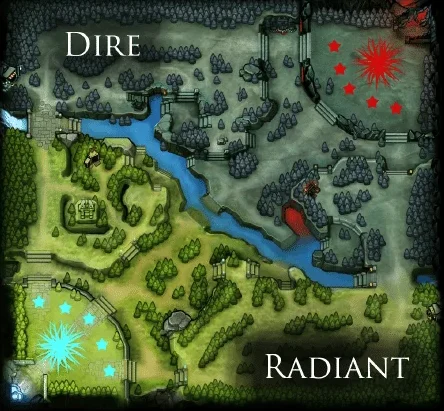
Dota 2 Map Overview
The Dota 2 map is the playing field where two teams of five players face off. It is divided into two diagonally-oriented territories (Radiant and Dire) separated by a river. The Dota map also has three lanes (top, middle, and bottom). We'll describe each of these in more detail below, but the key point is that they connect the teams' bases, and between them are jungles with neutral creeps.
We also need to remember the high ground and low ground areas. In short, high ground areas on the Dota 2 map provide advantageous vision and attack. At the same time, low ground areas, players lose visibility and are forced to guess the opponents' positions.
Dota 2 Patches and Map
Any detailed Dota 2 map review should start with patches. Patches in Dota 2 are updates released regularly by the developer Valve. Most often, updates fix bugs and adjust parameters. However, there are also major changes that significantly alter the meta, forcing teams to find new strategies.
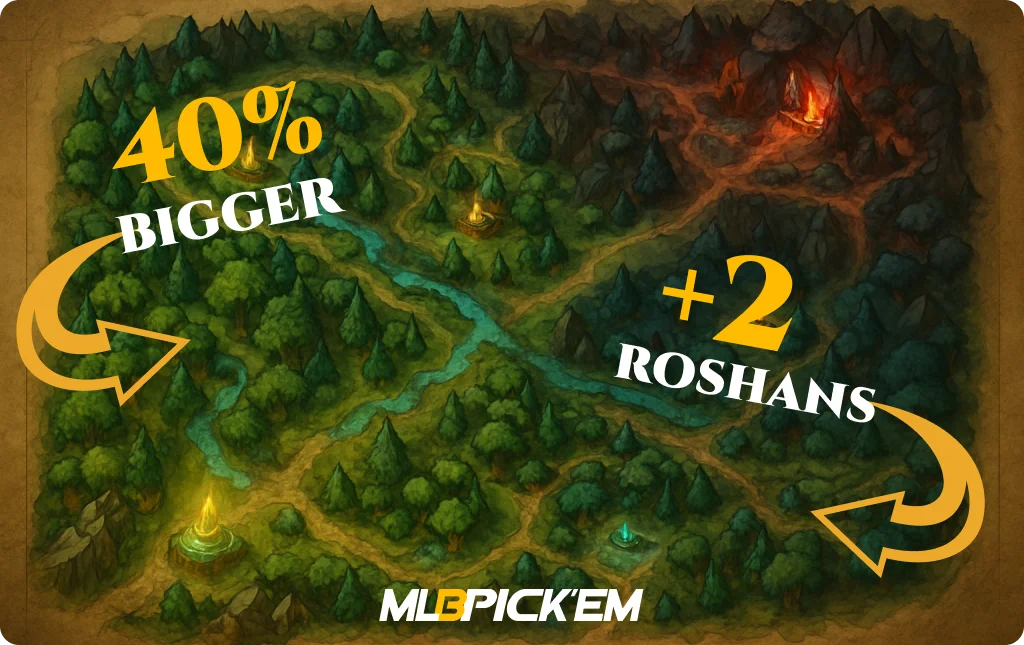
The Dota map has also been constantly changing due to patches. The most extensive Dota 2 map update in recent years occurred in version 7.33 “New Frontiers.” This update was released on April 21, 2023, and on that day, the Dota 2 map increased in size by almost forty percent. New objects such as Twin Gates, Lotus Pools, Ravagers, and Overseers were also added.
In subsequent updates, up until the latest, 7.39d, the developers have made targeted balance adjustments. They moved towers (7.39b), adjusted trees and neutral camps (7.38, 7.39), added streams and altars of wisdom (7.38), and reworked Roshan’s mechanics (7.38). All these seemingly minor Dota 2 map changes have a significant impact on strategy, forcing players to adapt anew each time.
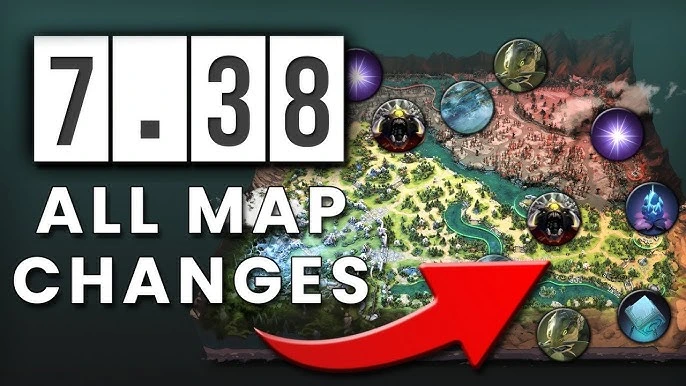
Dota 2 Lanes
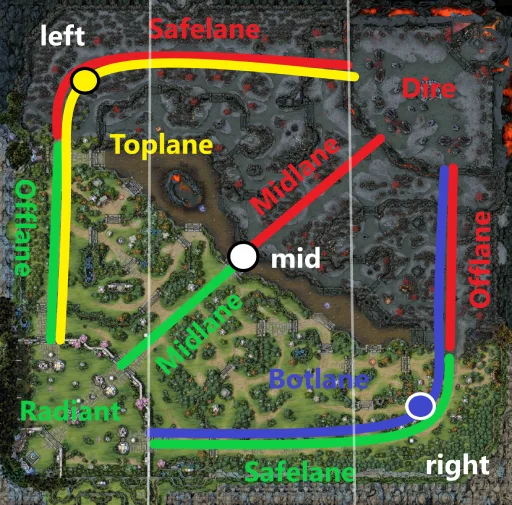
Dota 2 lanes are the roads that connect the Radiant and Dire bases. As mentioned earlier, there are three lanes: top, middle, and bottom. The geometry of these lanes varies, as does the length of the path from the tower to the creep encounter. It is this difference in length, proximity to the jungle, and tower positions that creates unique conditions for each role.
Top Lane
The top lane is often called the top or offlane. It connects the northern exit of the Radiant base and the western exit of the Dire base, running along the top and left edges of the map Dota 2. It starts at the northern gate of the Radiant base and runs due north. Upon reaching the high ground near the Dire base, it turns east. The key features of this lane on the Dota 2 map are the following:- Radiant is offlane, Dire is safe lane;
- The creep spawn point is located closer to the Dire tower;
- The proximity of the ramps to the river makes this Dota 2 lane vulnerable to ganks.
Mid Lane
The center lane is often called mid. It runs diagonally through the center of the Dota map and connects the northeastern gate of the Radiant with the southwestern gate of Dire. This is the shortest lane on the Dota 2 map without turns or additional passages. It is completely symmetrical for both sides. Key features of the mid lane:
- The shortest of all Dota 2 lanes, creep waves collide faster;
- Almost always played solo;
- Direct access to the top and bottom runes on the river.
Bottom Lane
The bottom lane is often called the bot or safe lane. On the Dota map, it connects the eastern exit of the Radiant base with the southern exit of the Dire base and runs along the right and bottom edges of the map. It starts at the eastern gate of the Radiant base and goes east. Then it turns north and leads directly to the Dire base. Key features of the bottom lane:
- For Radiant, this is the safe lane, for Dire, it’s the offlane;
- Creep waves converge closer to the Radiant tower, making farming easier;
- A nearby jungle is convenient for creep pulling.
The Dota 2 Jungle and Neutral Creeps
The Dota 2 jungle is a systemic element of the map, forming a secondary economy in the game alongside the lanes. It houses neutral creep camps, which provide gold, experience, neutral items, and create space for strategic actions. The structure of the jungle has changed dramatically over the course of Dota 2 patches:
- In 7.31, neutral creeps received stat scaling every 7.5 minutes;
- In 7.33, with the massive expansion of the Dota 2 map, 12 additional camps with unique auras were added (Well, Graveyard, Mine, Statue);
- In 7.38, the Dire Dota 2 jungle was reworked at the top. Several camps were also moved, which affected the pace of farming.
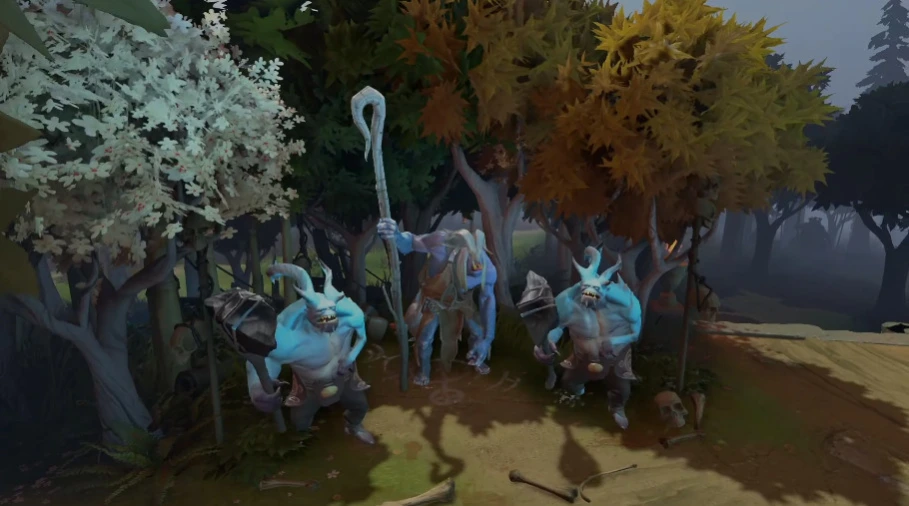
Key Mechanics of the Dota 2 Jungle
The Dota 2 jungle has its own mechanics. This is a set of techniques that determine how players interact with neutrals and use them for economics and map control. There are four main mechanics:
- Stacks: Artificially accumulate creeps in a camp. This is done by taunting at respawn timings. It provides carries with packs for accelerated farming and access to key slots;
- Pulls: Pulls lane creeps to the neutral camp. This moves the lane closer to the tower and slows enemy pushing. It provides gold and experience to supports;
- Camp Blocking: A ward or unit in the spawn zone disables neutral respawns. It is used for pressure: small camps are blocked to stop pulls or large ones to slow down the carry’s farming. It can only be countered by sentries and zone checking;
- Neutral Scaling: Added in patch 7.31. Every 7.5 minutes, neutrals are empowered, gaining health, armor, damage, attack speed, and increased rewards. By the 225th minute, they become mini-bosses.
Neutral Camp Types
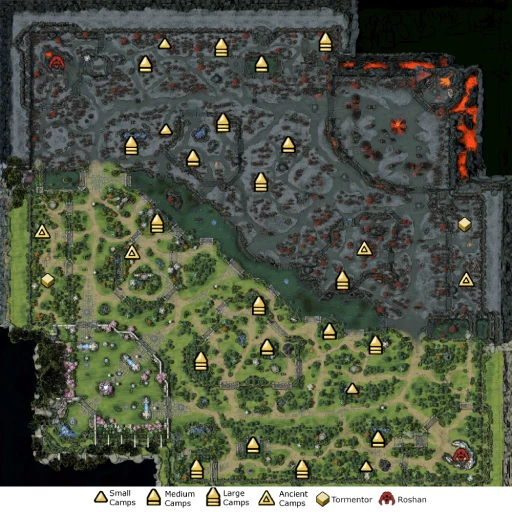
The Dota 2 jungle is home to neutral creep camps, which vary in strength and value. Each camp on the Dota 2 map has its own set of creatures and characteristics that influence farming speed, item timings, and team resource distribution.
All neutral camps in Dota 2 are divided into four categories. In addition, there is a fifth special camp – Roshan:
- Small camps: Located closest to the lanes of the Dota 2 map, they are used by supports for pulls and lane disruption. They provide minimal income but are important for lane control;
- Medium camps: These are considered a transitional source of farm. Suitable for heroes with AoE damage, summons, or built-in lifesteal, they are considered an intermediate source of gold and experience;
- Large camps: Comparable in value to a full creep wave. Clearing large Dota 2 camps through stacks forms the core of the carry’s economy and accelerates the progression to key timings (BKB, Radiance, Manta);
- Ancient Camps: These camps have high armor and auras. They require heroes with strong AoE abilities or items like Helm of the Dominator. Controlling these camps on the Dota map often determines the macroeconomic outcome;
- Roshan: A unique neutral with a lair and separate mechanics. Grants an Aegis, and after several kills, a Shard, Cheese, Refresher, or Blessing. After the Dota map changes in patch 7.33, Roshan’s lairs are located at the edges.
Key Objects of the Dota 2 Map
Buildings in Dota 2 are a special type of unit, not controlled by players. At the start of a match, each team receives the same set of buildings at fixed points on the Dota 2 map. While the architecture of Radiant and Dire differs visually, the functional set of buildings is identical. In terms of function, their primary role is to defend territory, control lanes, and create key objectives for the enemy.
Towers
Towers are a team’s defensive line, located along three lanes and at the base. There are four different tower tiers on the Dota 2 map:
- T1 – the first strongholds on the lane;.
- T2 – strategic nodes, holding which provides access to the jungle and defense of their territory;
- T3 – act as a barrier in front of the base;
- T4 – are the final line of defense before Ancient.
Towers provide vision and control of the map Dota 2. During the day, each tower reveals territory within a 1900 unit radius. At night, this stat drops: for T1, it drops to 600, and for T2, T3, and T4, to 1100. All towers have a built-in reveal for invisible units within a 700 radius, making them natural defense points against ganks and roamers.
Ancient
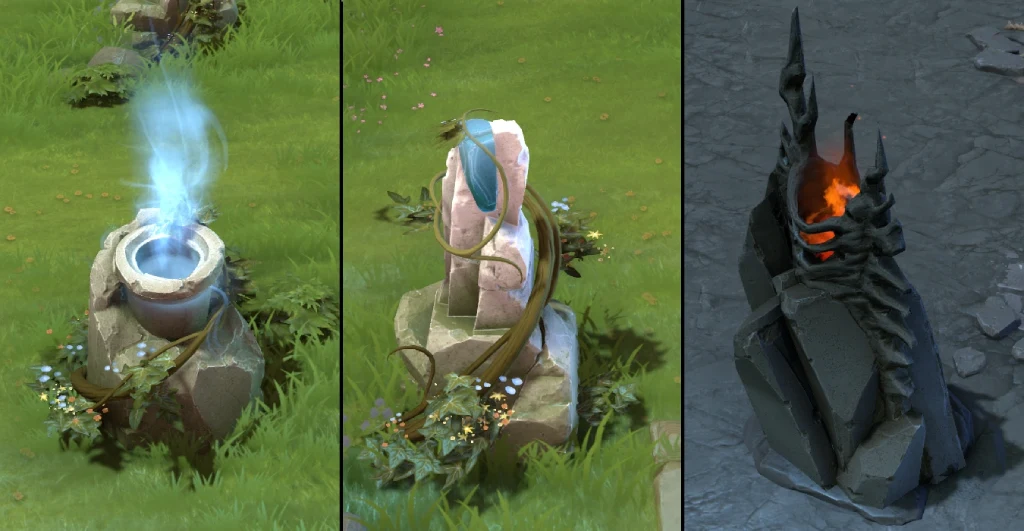
The Ancient is the main objective of the base and the ultimate goal of the entire game. It is located in the center of the base and is protected by two T4 bases. Until these two towers are destroyed, it is invulnerable.
It is also interesting that it is the most defensible object on the Dota map: 4500 HP, 12 health regen, 23 armor, and built-in Backdoor Protection. Regardless of the team’s strategy, the ultimate goal of the game is always to destroy the Ancient.
Fountain
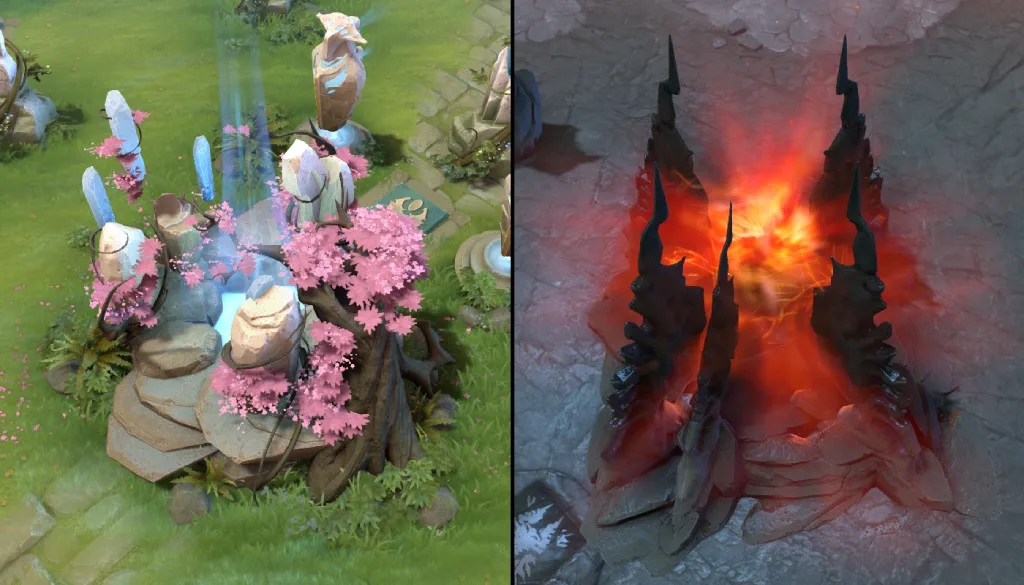
The Fountain is the main defensive structure in the spawn zone. It is completely invulnerable and serves both as a recovery point and as an absolute barrier against enemy heroes. The fountain’s aura restores 5% health and 6% mana per second within a 1200 radius, refills the Bottle, and grants temporary invulnerability after respawning.
Stats as of patch 7.39d: attack damage 290–310, base attack time 0.15, range 1200, projectile speed 1400. Each hit is amplified by +3 damage per stack, making the fountain the deadliest source of damage in the game. Vision: 1800 day and night, plus 1200 true sight.
Roshan and Aegis
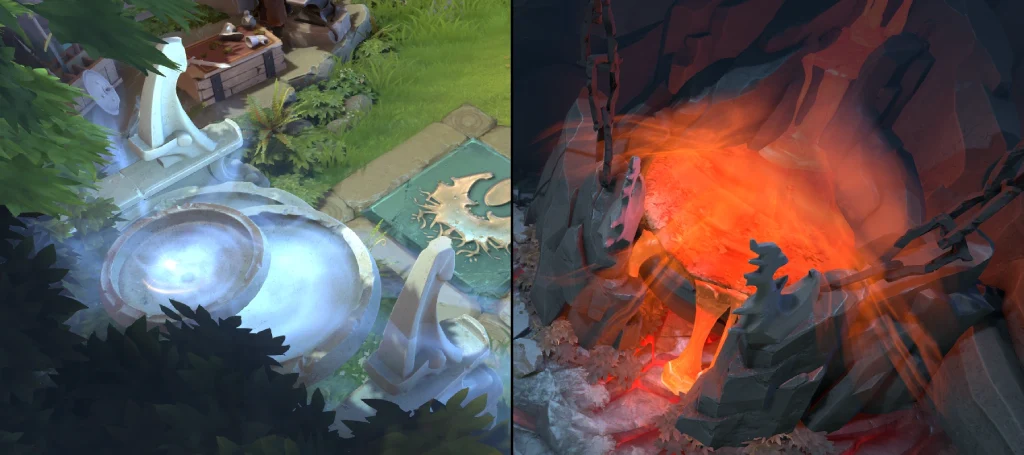
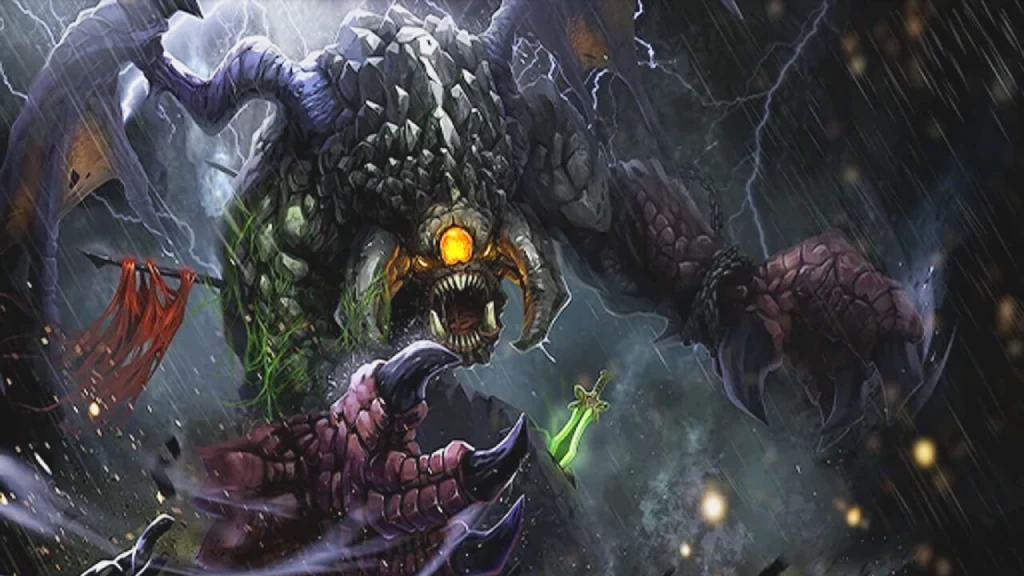
Roshan is the main neutral objective on the Dota 2 map. Many experienced players call him “the key to the game’s tempo.” He appears on the Dota map immediately after the match starts, in his lair located by the river between the mid and bot lanes. His stats scale over time. He starts with 6000 HP, 20 armor, and 75 damage, and gains additional health, armor, and damage every few minutes. By the 40th minute, Roshan becomes a full-fledged mini-boss, unbeatable even for a carry.
Killing this neutral not only grants gold (200-290 personal + 135 to each ally) and experience (400 +20 per minute), but also unique artifacts:
- Aegis of the Immortal (each kill) – immortality for one hero, respawning after 5 seconds with full HP/MP;
- Cheese (from 2nd death) – Instantly restores 2500 HP and 1500 MP;
- Refresher Shard (from 3rd/4th death) – Resets skill and item cooldowns;
- Aghanim’s Blessing (from 3rd/4th death) – Permanently upgrades your ultimate or grants a new ability.
Runes and River Control
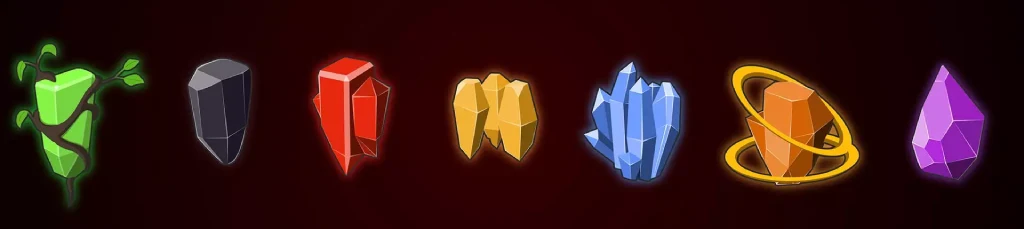
The river divides the Dota 2 map into two halves. It serves as an important control zone due to the runes that spawn. Proper control of these Dota 2 runes is a resource for midlaners, a source of gold and experience for the entire team, and one of the main factors in successful ganks. There are four types of runes in the game, each with its own timings and spawn zones on the Dota 2 map.
Power Runes
- Spawn every 2 minutes starting at 6:00, randomly at the top or bottom of the river;
- Types: Double Damage (+80% damage and +15% ability damage for 45 sec), Haste (550 movement speed for 22 sec), Invisibility (45 sec, activates after 2 sec), Illusion (2 copies of the hero, last 75 sec), Regeneration (6% HP/MP per sec, up to 30 sec), Arcane (-30% cooldown and mana cost for 50 sec).
Bounty Rune
- Spawns from 0:00 and every 3 minutes in the forest points of the Dota 2 map;
- Grants gold to the entire team: 40 at the start, +36 every 5 minutes.
Water Rune
- Spawns only at 2:00 and 4:00 at both points of the river;
- Restores 40 HP and 80 MP, ideal for mid laners.
Wisdom Rune
- Spawns at 7:00 AM and every 7 minutes at the edges of the map Dota 2;
- Grants 280 XP to the ally who activates it and the one with the lowest XP.
Outposts and Vision
The Dota map is read through vision. Vantage points, wards, and neutral objects form the basis of macroplay. Proper vision allows you to read enemy movements, control key timings (runes, Roshan, stacks), and safely engage in fights.
Outposts
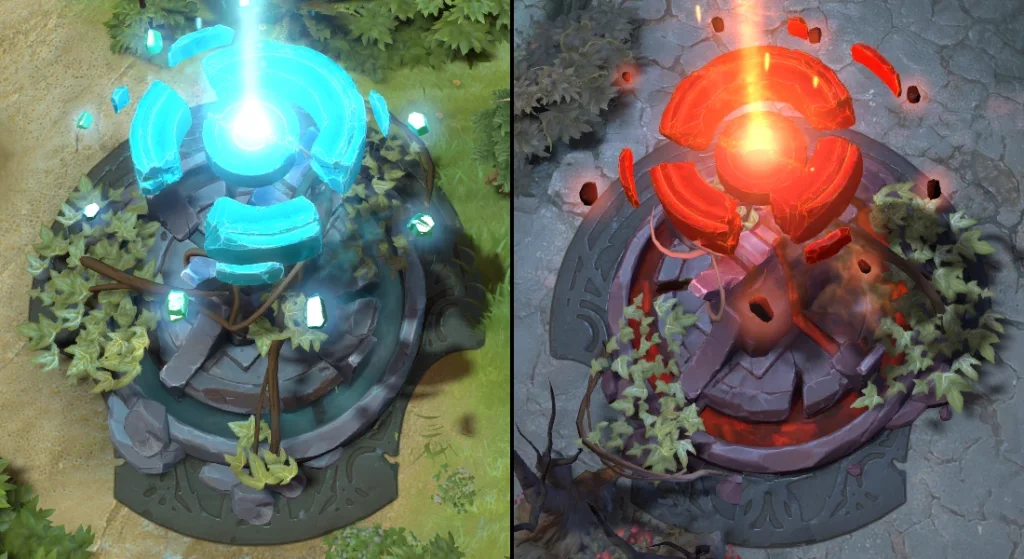
There are four outposts on the Dota 2 map. Two are in the primary jungles and can be captured after destroying the nearby Tier 2 tower, while the other two at the map edges near the safe lanes cannot be captured.
- At the start, each is controlled by its own faction. An opposing outpost can only be captured after destroying the nearest T2 tower;
- The capture time is fixed at 6 seconds, divided by the number of heroes. Three heroes can capture an outpost in 2 seconds, five in 1.2 seconds;
- Once captured, an outpost provides a teleportation point with a basic 6-second animation and vision in a 500-radius range;
- Controlling outposts provides quick access to key areas of the Dota map: the Rosh Pit, the Triangle, and the Jungle.
Observer and Sentry Wards
- An Observer Ward provides 1600 unit vision for 6 minutes;
- A Sentry Ward reveals invisibility in a 900 unit radius and lasts for 8 minutes;
- Wards cannot be sold or refunded. Misplacement = lost economy and no map.
Watchers
- Introduced in patch 7.33. Initially, there were eight, but in patch 7.35, their number on the Dota 2 map was increased to ten;
- Activated by a hero for 1 second, they provide 800 unit vision;
- After activation, they last for 7 minutes, then go on cooldown;
- Watchers do not replace wards, but allow the team to maintain vision in high-priority areas without spending extra money.
New Dota 2 Map Objects
Patch 7.33 added new strategic objects to the Dota 2 map. Now, in addition to the jungle and runes, teams must consider rotation portals, constant regeneration points, and minibosses.
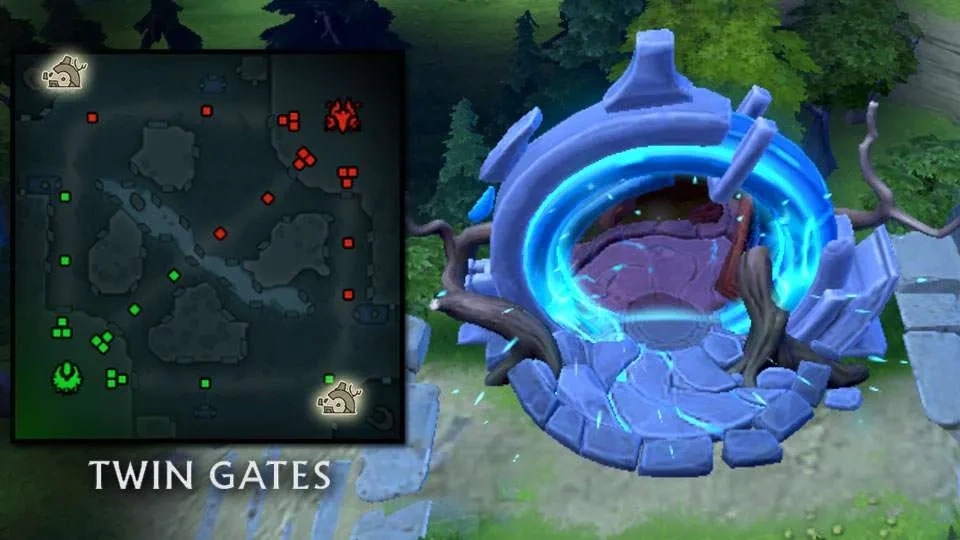
Twin Gates – Twin Portals
Twin Gates give teams a new tool for quick rotations and unexpected smoke ganks. Any mistake in portal control is immediately punished.
- Located in the northwest and southeast corners of the Dota map, near Roshan’s lairs. There are two of them on the map;
- Twin Gates are accessible to both teams and allow them to channel across the entire map in 4 seconds. Using them costs 75 mana;
- Rooted or lished players cannot use the portals, but silences and disarms do not interfere. Activating them does not interrupt projectiles or disrupt the order queue.
Lotus Pools – A Source of Regeneration
Lotus Pools stabilize resources in long games. Their control is critical for mid and offlaners who value a constant mana supply.
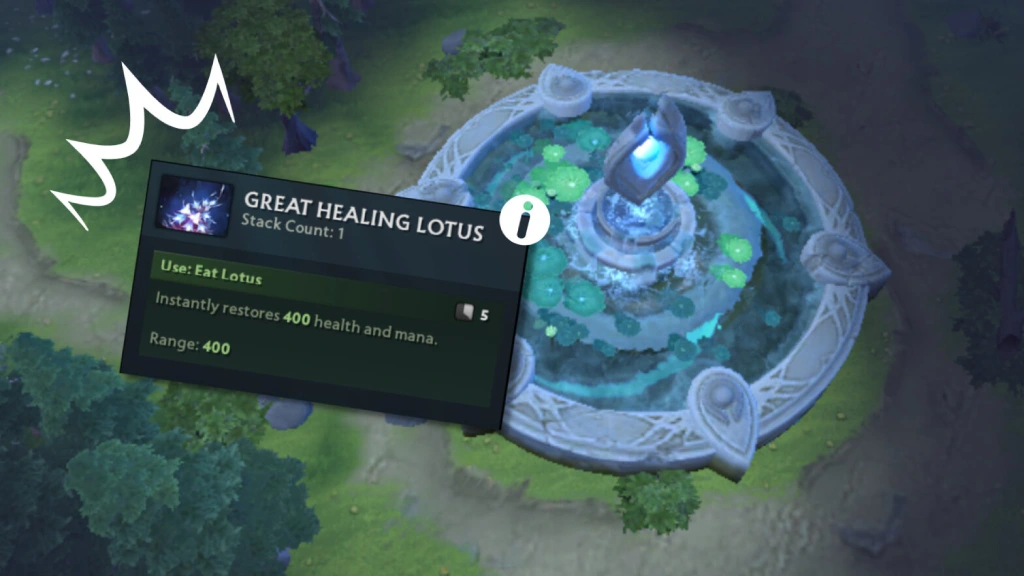
- Two pools are located at the edges of the Dota 2 new map (left and right). Every 3 minutes, they create a Healing Lotus, up to 6 per cycle;
- Three small lotuses combine into a Greater Lotus (+400 HP/MP), and two Greater Lotuses combine into a Grand Lotus (+900 HP/MP);
- The collection process is channeled: one lotus per second. Enemies always see the process — the pools provide vision within a 400-degree radius.
Tormentors – Mini-Bosses with Aghanim’s Shard
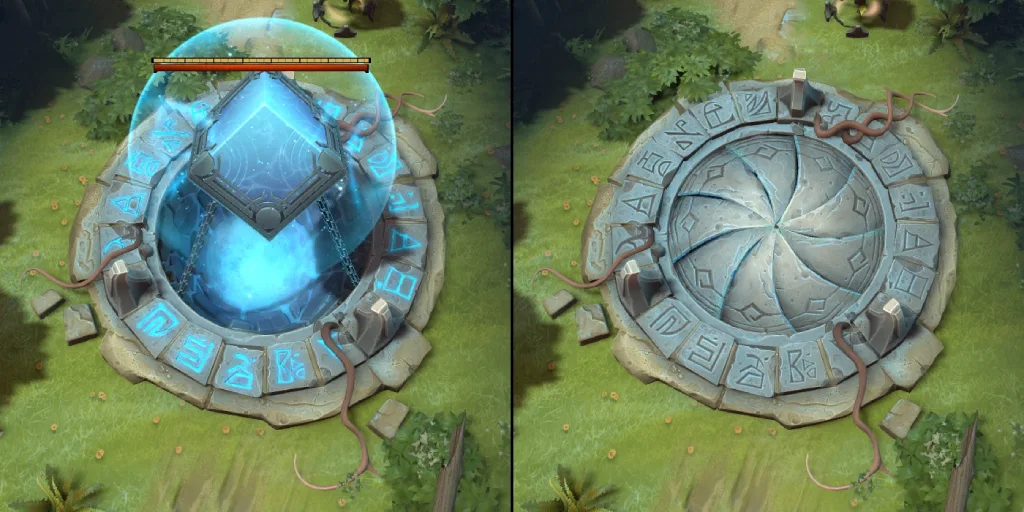
Fighting for Tormentor has become a mandatory element of macro play after the 20-minute mark. This is a “free shard” in exchange for a team move:
- Located behind the T2 offlane towers, one on each side. They appear at the 20-minute mark and respawn after 10 minutes;
- They have no attacks, but they have a 2500 damage barrier that regenerates at 100 HP per second, reflects 90% of incoming damage to all heroes within a 1200 radius, and an aura that deals 30 magic damage per second. With each death, the bosses become stronger;
- Reward: One of the two heroes with the lowest net worth on the team receives Aghanim’s Shard. If everyone has the Shard, the team receives 280 gold and XP, and the hero who finishes them off receives an additional 250 gold.
Conclusion
Map knowledge is one of the most important components of success in Dota 2. This is true for players of all skill levels. Even if you’ve played for thousands of hours, if you don’t keep up with the latest Dota 2 map changes, you risk losing to your opponent simply because you’re not taking into account new routes, objectives, or control opportunities.
Every victory in Dota 2 is built on map knowledge. Understanding its mechanics, the intricacies of the terrain, and rotation points gives any team a strategic advantage. So study the changes, practice their application in matches, and put them into practice. Learn the Dota map and dominate matches!
FAQ
The Dota 2 new map is shaped like a square with sides measuring 15,000 game units. The total area is 225,000,000 square units (15,000 × 15,000). This is approximately 5 times the size of a football field or 3.6 times the size of the classic DotA Allstars map in Warcraft III.
Patch 7.39d didn’t make any fundamental adjustments to the Dota 2 map. There are only a couple of minor tweaks: ancient creep spawn zones have been expanded, a buggy ward spot has been removed, and several trees have been removed. However, these shouldn’t be ignored, as even such minor adjustments impact vision and farming timings.
Roshan is the main neutral on the Dota 2 map, with dynamic stat scaling starting at 6000 HP and 20 armor. Killing him grants an Aegis, Cheese, Shard, or Blessing, and control of the lair determines the pace of the game: pushing, buybacks, teamfight strategy, and team resource balance.
Neutral creeps spawn every 60 seconds, starting at 0:30, and are buffed every 7.5 minutes—up to +30 HP, +0.5 armor, and +5 XP. This scaling makes the jungle relevant until the ultra-late game. Stacking for BKB or Radiance timings determines the carry’s economics.
Twin Gates are twin portals in the corners of the Dota 2 map, allowing you to instantly switch sides in 4 seconds and for 75 mana. They shortened rotation times, increased Roshan control, and discovered new ganking strategies. Smart use of Twin Gates wins macro.
The safe lane on the Dota 2 map depends on the side: for Radiant, it’s the bottom lane, for Dire, it’s the top lane. It’s closer to the base, protected by a T1 tower and has access to a small camp for pulls. This is where the carry gets the most stable farm with minimal risk.
Read also: