mn
mn  ru
ru 
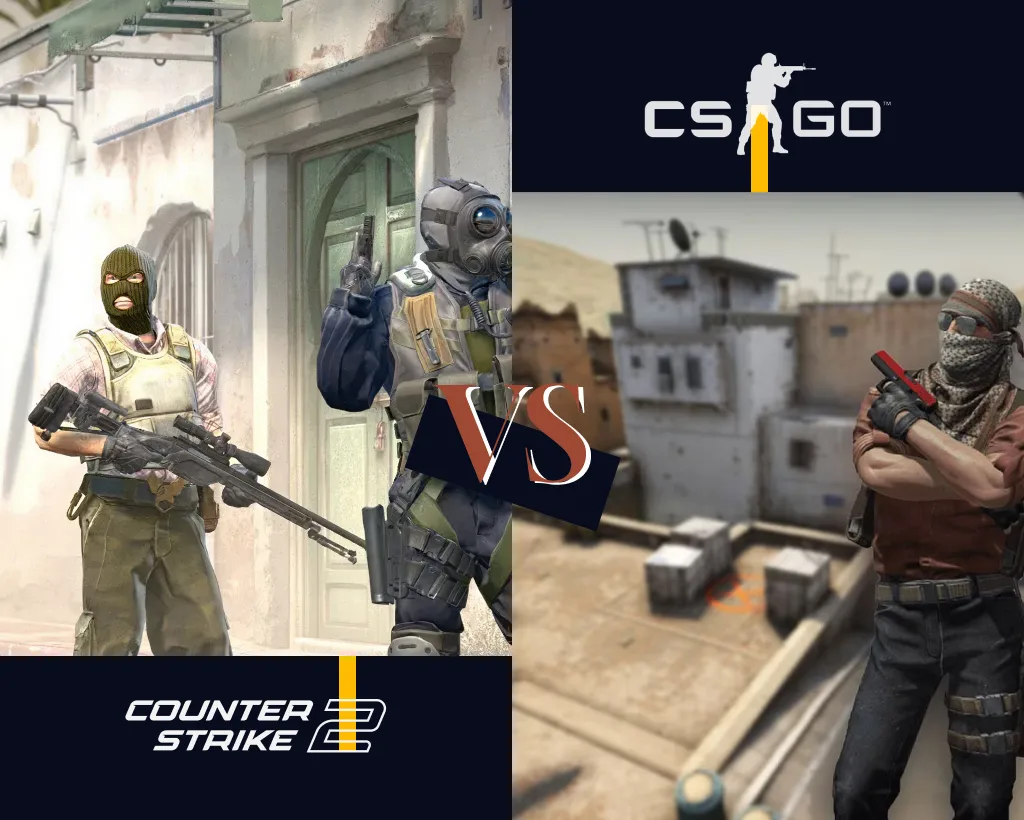
CS:GO vs CS2 — Side-by-Side Review 2026
For over two years now, we’ve all been playing the new version of the legendary Counter-Strike series. But have you ever wondered how CS2 actually differs from CS:GO? The changes aren’t just a matter of adding a “2” to the name. In this article for MelBet Pick’em, we’ll be comparing CS:GO vs CS2 in detail. You’ll know even the most subtle changes if you read our article to the end!
CS2 vs CS:GO: Key Differences at a Glance
We know that not everyone enjoys long articles. So, for those looking for a quick comparison of CS:GO and CS2, we’ve prepared a short table. It summarizes the main changes.
However, we still recommend reading the full CS:GO vs CS2 comparison. Only then will you be able to understand the smallest changes and understand why CS2 is better than CS:GO!
| Criteria | CS:GO | CS2 |
|---|---|---|
| Engine | Source | Source 2 |
| Graphics | Basic lighting & textures | Modern PBR, HDR, improved visibility |
| Movement | Classic movement feel | Updated animations, heavier inertia |
| Sound | Older sound engine | Enhanced positional audio & sound radar |
| Maps | Legacy layouts | Overhauls, upgrades, full remasters |
| Tick / Subtick | 64 / 128 tick | 64 tick with Sub-tick |
| Main Competitive Mode | Competitive matchmaking | Premier |
| Rounds (Competitive) | MR15 | MR12 |
| UI | Radial buy menu | Grid buy menu, improved HUD |
What Is CS2?
Many players ask what CS2 is, thinking it’s a completely new game. But that’s not the case. To put it bluntly, CS2 is still the same Counter-Strike: Global Offensive (CS:GO), only on a new engine and with a number of changes. Therefore, the answer to the question “Is CS2 the same as CSGO?” is “yes, but with an updated technological foundation.”
On the day of CS2’s release on Steam, CS:GO was simply replaced. On September 27, 2023, the CS:GO page on Steam automatically updated to the CS2 page, and the previous version immediately became officially unavailable for download.
This is significantly different from previous games in the series. For example, Counter-Strike: Condition Zero (2004) and Counter-Strike: Source (2004) are still available on Steam. They are separate games, and even now, in 2026, you can download each of them. The original, legendary version, released in 2000 and known as Counter-Strike 1.6, is also available.
Previously, each version of Counter-Strike existed in parallel. You could play different versions depending on your mood. CS2 was the first time a new version completely superseded the previous one, updating the core game but preserving its structure, inventory, and accounts.
Source 2 Engine — Graphics, Lighting & Physics Upgrade
The most important change, always discussed first when comparing CS:GO vs CS2, is the engine. For those not well-versed in technical details, it’s the so-called “skeleton” and “brain” of the game. It’s responsible for everything:
- How the image looks;
- How the CS2 map is lit;
- How shadows and reflections work;
- How characters move;
- How collisions, physics, and effects are calculated;
- How the game loads, optimizes, and interacts with the computer.
In other words, the engine is the foundation of the game. When it changes, absolutely everything changes, and in CS2, the transition to the Source 2 engine was made. This is considered the most significant technological leap in the history of the Counter-Strike series. And the most noticeable changes for players are in the graphics and lighting. They catch the eye in the first minute of the game.

CS2 Graphics Improvements Over CS:GO
It might initially appear that CS2 simply updated the textures. However, in reality, a complete rendering overhaul was performed.
In the previous version of the game (CS:GO), the image was built on an old shader set without a physically based lighting model. In the new version, CS2 graphics rely on a new rendering pipeline. It is based on PBR (physically based rendering), volumetric effects, and modern lighting.
The main improvements to CS2 compared to CS:GO are as follows:
- High-polygon models of players, weapons, and the environment.
- Point, directional, and global light sources with correct physical response.
- Surfaces now have realistic properties. Metal has a metallic sheen, concrete reflects minimally, and leather and fabric have natural depth.
- Water surfaces and glass now have full reflections and refractions.
- Small geometric details on maps (bricks, tiles, wood) are now much more visually “readable.”
The developers have achieved the impossible. They were able to preserve the franchise’s familiar art style while giving the game a significantly more modern look.
Dynamic Lighting, Reflections, Shadows
Although many people attribute lighting to graphics, when comparing CS2 vs CS:GO, we’d like to focus on it separately. In the older version of CS, most of the lighting was pre-baked. This is called flat, baked lighting. In CS2, everything is now dynamic, making the maps visually alive.
The redesigned CS2 lighting system, built on a physically based lighting model, supports HDR, PBR, and highly accurate real-time shadows. Unlike the outdated CS:GO lighting model, the new system fully takes into account:
- Light angle,
- Light intensity,
- Surface character,
- Global reflected rays,
- Ambient occlusion.
Reflections now work even on dynamic objects (weapons, special effects, and partially the player). Previously, they only worked on static surfaces. This change in CS2 allowed highlights, player shadows, grenade reflections, and flashes to provide much more information about what’s happening.
Performance Impact — CS2 Hardware Requirements vs. CS:GO
The graphics changes and the introduction of the new Source 2 engine could not help but affect performance. The new rendering and effects system looks beautiful, but it significantly increased the load on the hardware. This forced the developers to update the CS2 system requirements, making them significantly higher than those of CS:GO. Players with weak systems, of course, did not like this. But, unfortunately, the developers left them no choice.
We’ve prepared a comparison table of the minimum system requirements for CS2 and CS:GO:
| Component | CS:GO | CS2 |
|---|---|---|
| Operating System | Windows 7/Vista/XP | Windows 10 |
| Processor (CPU) | Intel Core 2 Duo E6600 (2×2.4 GHz) / AMD Phenom X3 8750 (3×2.4 GHz) | 4-thread CPU – Intel Core i5 750 or better |
| RAM | 2 GB | 8 GB |
| Graphics (GPU) | 256 MB VRAM, DirectX 9, Pixel Shader 3.0 | 1 GB VRAM, DirectX 11, Shader Model 5.0 |
| DirectX | DirectX 9 | DirectX 11 |
| Storage | 15 GB | 85 GB |
The changes are noticeable to the naked eye. However, these are still very low requirements for a game released in 2023. The graphics in Counter-Strike 2 are very beautiful, and such low requirements indicate that the developers have done a good job with optimization.
Also, one of the nice things about the hardware is the better use of multi-core CPUs in CS2. CS:GO was released way back in 2012. Back then, processors were typically dual-core, rarely quad-core. That’s why they didn’t bother much with optimization back then, and the game used mainly 1-2 cores, with the others barely being loaded.
Now, in 2026, the average number of CPU cores for Steam users is 6 (28.69%). A huge number of users (25.80%) also have processors with as many as 8 cores. Therefore, the developers simply couldn’t ignore optimization for multi-core systems.
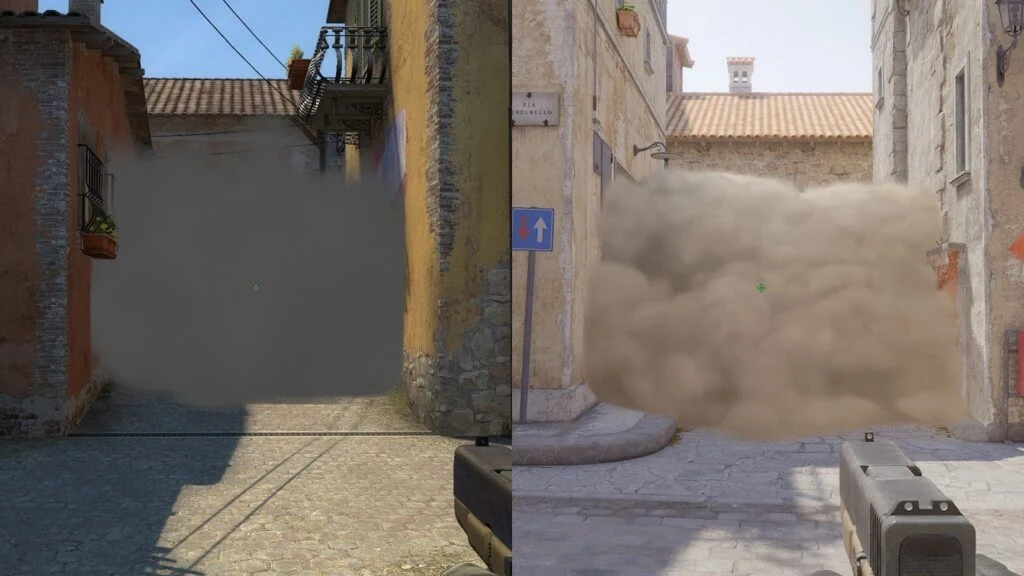
CS2 Smoke Grenades vs. CS:GO Smokes
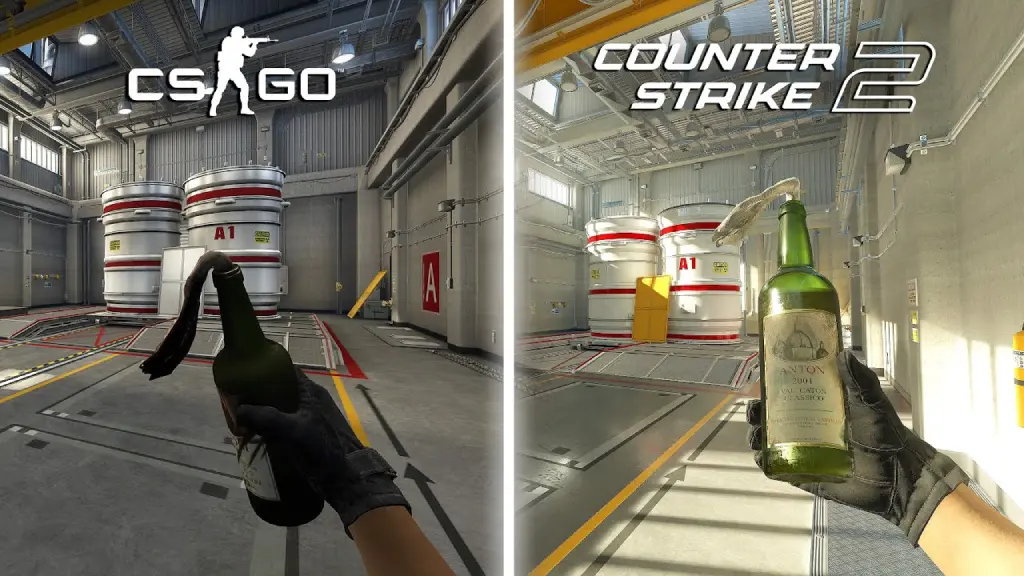
A very noticeable change in CS2 concerns grenades. The Molotov/Incendiary Grenade now looks much, much better. This is thanks to the new engine with improved graphics.
However, the biggest change has been in CS2 smokes. Smoke is now not just an effect, but a physical object. It can be interacted with (dispersed by gunfire or other grenades), and it also takes into account the map’s geometry. It disperses through open doors and broken windows, descending or ascending stairs.
This affects not only the visual appearance but also which corners are obscured, which pixels are visible, and so on. For ease of reference, we’ve compiled a short table comparing CS:GO vs CS2 smokes:
| Criteria | CS:GO Smokes | CS2 Smokes |
|---|---|---|
| Type | Static particle cloud | Volumetric 3D smoke |
| Shape | Fixed spherical shape | Adaptive shape based on map geometry |
| Geometry Interaction | Minimal interaction with surfaces | Fills stairs, corners, windows, tight spaces |
| Bullet Interaction | No effect | Bullets create temporary visibility gaps |
| HE Interaction | No effect | HE grenade temporarily clears sections of smoke |
| One-Way Smokes | Common and abusable | Mostly eliminated (unified volumetric model) |
| Consistency | Static and predictable | Dynamic, slightly shifting over time |
| Visibility Control | Fully blocks vision | Partial, interruptible by actions |
Tick Rate vs. Sub-Tick System — The Biggest Gameplay Change
When comparing CS:GO vs CS2, it’s impossible not to mention the tick rate. This is the number of times per second the server “takes a snapshot” of the game and recalculates all events (shots, movement, player position, grenades, damage, etc.).
The beloved CS:GO had a classic tick rate, in which the server updated in fixed “tick cycles” (64 ticks on Valve servers and 128 ticks on Faceit/ESL).
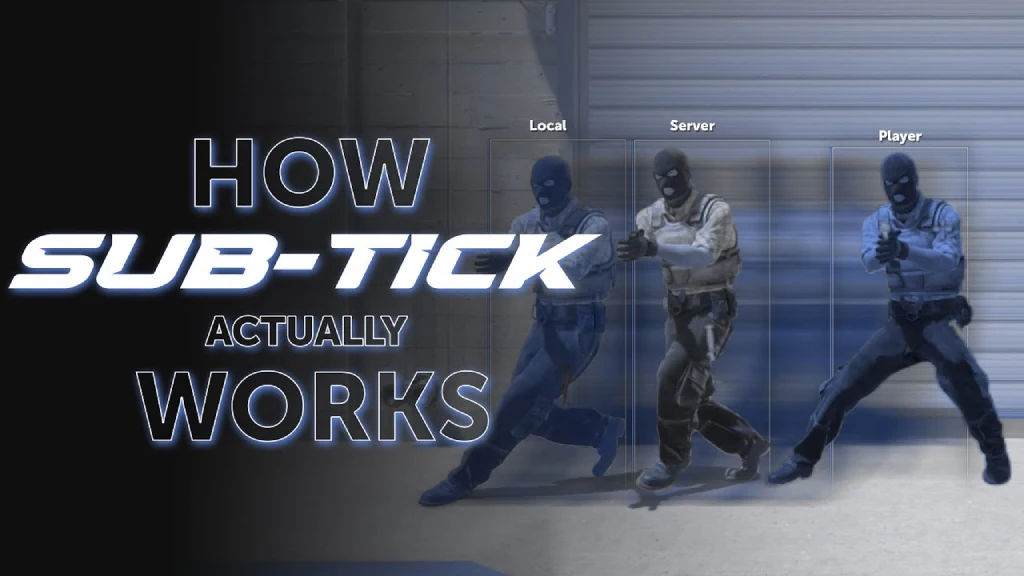
In 2023, with the transition to CS2, a new sub-tick architecture was introduced. Now the server processes all actions immediately as they occur, not just at the server tick.
How the Sub-Tick Architecture Works
To understand what a sub-tick is, you need to compare it to the classic tick rate.
In CS:GO
- The server processed the game 64/128 times per second.
- All player actions were “adjusted” to the next tick.
- Shots, jumps, and strafes were updated in discrete steps.
In CS2
- The server records the exact time of each action: a mouse click, a jump, a grenade throw.
- These actions don’t wait for a tick. They are recorded “as soon as they happen.”
- At the next tick, the server plays back an ordered list of actions with their timestamps.
As a result, the CS2 tick rate formally remained the same (64). But if we look at a real game, the action processing logic has become “continuous.”
Movement & Gunplay: CS2 vs CS:GO Changes
The transition to Source 2 changed the basic feel of movement and shooting in CS2. These changes are not as noticeable to casual gamers, but professional players quickly noticed them.
Player Model Movement Changes
The movement changes in CS2 affected all components of movement:
- The model takes longer to accelerate and stop;
- Jiggle peeks are less abrupt;
- Movement animations are more realistic, but sometimes misalign with the hitbox;
- Sub-tick increased peeker advantage by changing micro-peek timings.
Recoil, Spray Patterns and Weapon Feel
The transition to Source 2 changed the shooting physics, visual feedback, and network hit processing. For the most part, the changes are visual, not mathematical:
- Visual feedback (camera + model) has become stronger;
- The spray is harder to read visually, although no changes to the spray itself have been announced;
- The weapon feels “heavier” due to new animations, tracers, and sounds;
- The Hitreg has become technically more accurate, but subjectively sharper.
All CS Maps Changes — Overhauls, Upgrades & Touchstone Maps
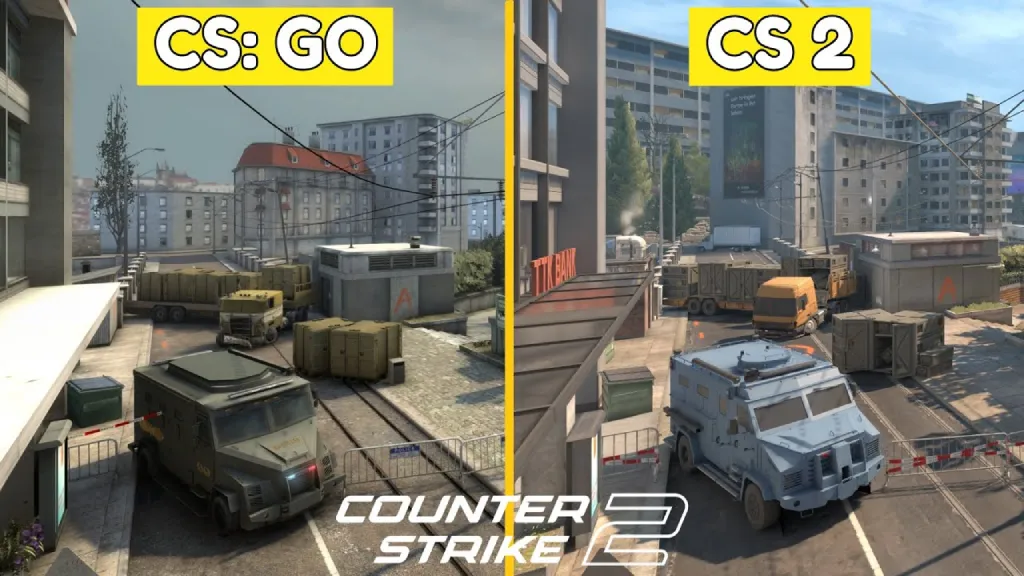
The move to Source 2 led to a complete overhaul of Counter-Strike maps. There are many changes, most of which are visual, but some maps also feature modified geometry.
To examine the changes in more detail, all CS2 maps can be divided into three categories.
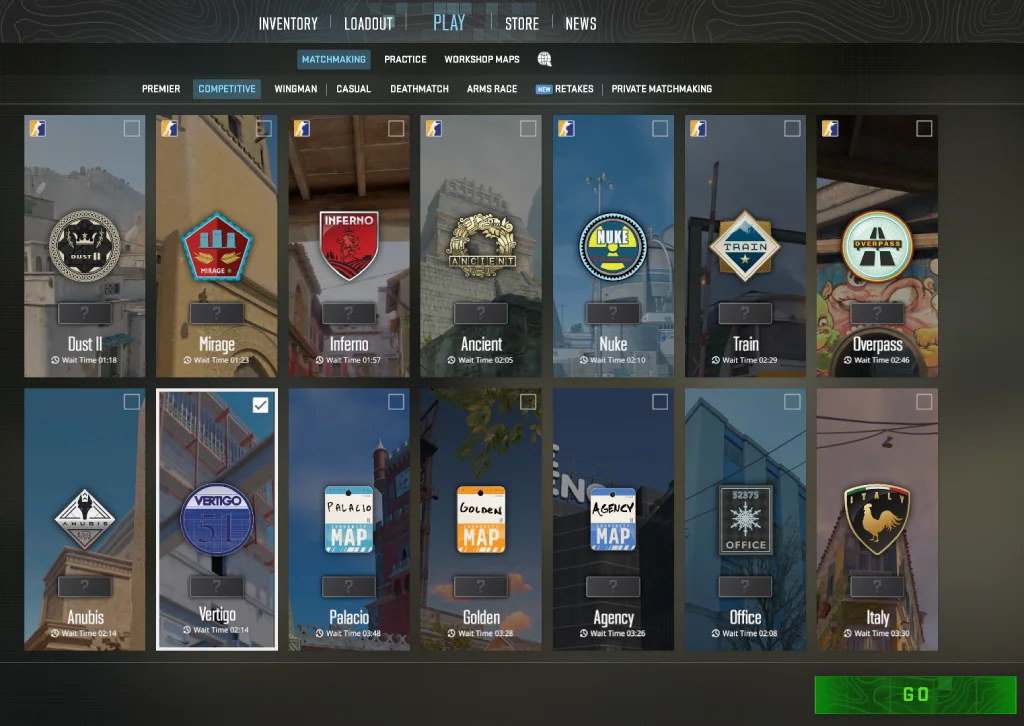
1. Touchstone Maps (Dust2, Mirage)
Touchstone maps are maps where Valve retained the most recognizable structure. Timings and macro routes were fully preserved. As a result, two of the most popular CS2 maps (Dust2 and Mirage) received:
- Updated lighting (HDR + PBR materials);
- Improved object readability;
- Reworked textures;
- Smoother contours of models and positional objects.
2. Upgrade Maps (Nuke, Ancient, Anubis)
The Upgrade category includes maps where Source 2 allowed Valve to improve the visuals and lighting without changing the fundamental layout. Key changes:
- Global scene rendering has become clearer (dark areas are more visible);
- PBR materials have been reworked;
- Shadows and reflections provide more information;
- Player silhouettes are now more visible at a distance.
For example:
- Nuke now has much more uniform lighting inside buildings.
- Ancient has received improved shadows and color correction.
- Anubis has gained visual depth thanks to Source 2 water and volumetric lighting.
3. Full Overhaul Maps (Inferno, Overpass, Train)
Overhaul maps have been completely rebuilt from the ground up using Source 2 tools. These maps feature changes to:
- Geometry;
- Zone sizes;
- Lighting.
Looking at specific examples for each map, the following changes stand out:
- Inferno received a new mid-view, a redesigned Banana, and a completely updated interior A.
- Overpass has become more logical in geometry and is better readable at key choke points.
- Train has been completely rebuilt, making the map visually modern.
CS2 UI & HUD Rework — New Buy Menu & Quality-of-Life Changes
The next change concerns usability. Yes, we’re talking about the CS2 UI and HUD. The information display system has been completely redesigned. The developers spent over 10 years analyzing how players read information and make weapon purchase decisions.
This has all resulted in improved readability of the CS2 interface. Almost everything has changed: the buy menu, HUD icons, information structure, grenade handling, and kill feed.
New Buy Menu vs. CS:GO’s Radial Menu
In CS:GO, the radial buy menu was a historical legacy. It scaled poorly for modern gameplay. Players constantly had to remember input patterns and spend time navigating. The CS2 buy menu has been redesigned, and the main changes are as follows:
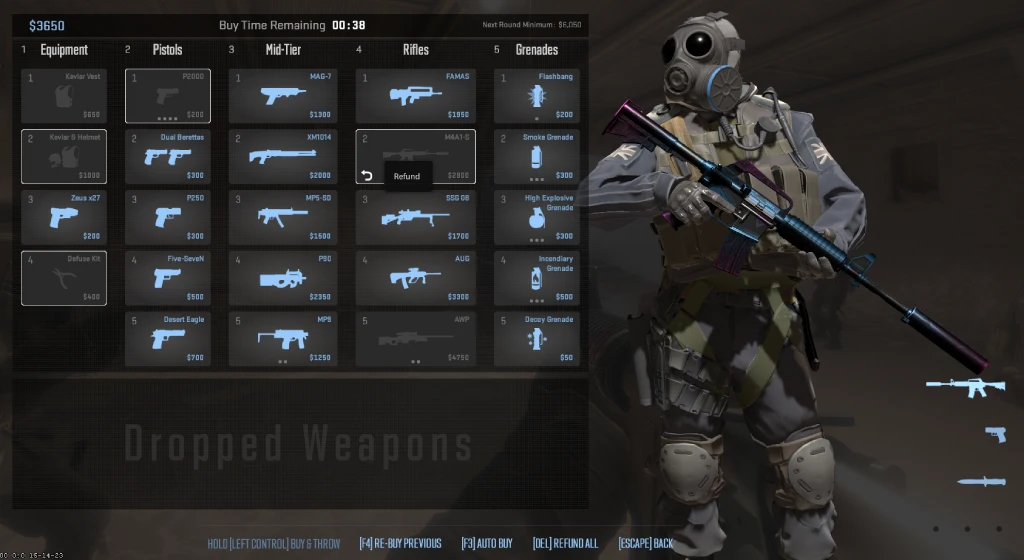
- A grid interface is now used, with weapons divided into categories (Pistols/Mid-Tier/Rifles/Equipment/Grenades).
- A loadout system has been added. In it, the player pre-selects a limited pool of weapons available in the match. This, first and foremost, speeds up decision-making. Also, from a psychological perspective, it reduces cognitive load.
- A refund feature has been added during the buy-time period. Misclicks are no longer scary and that’s great.
Follow Recoil, Grenade Line-Up Reticle & Grenade Camera
CS2 introduced several QoL features to the HUD that are directly related to gunplay and utility. This was done to close the long-standing gap between newcomers and veterans.
- Follow Recoil: An option where the crosshair follows the weapon’s actual spray pattern, rather than remaining statically fixed. This lowers the learning curve for working with spray patterns. The player sees the “live” recoil vector and learns to compensate for it visually, not just by muscle memory.
- Grenade Line-Up Reticle: When holding LMB with a grenade, the HUD displays a fixed “lock-in” indicator when the angle, height, and position for the throw line match the saved value. This essentially serves as a built-in line-up hint.
- Grenade Camera (in training mode): Allows you to see the trajectory and final point of the grenade before using it. This simplifies practicing Smoke and Molotov cocktails. The player can perfect setups down to the pixel.
New Killfeed Features (Airborne, Blinded, Wallbang Tags)
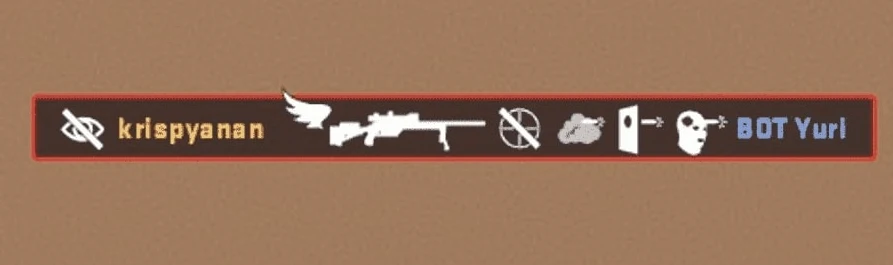
The frag list now provides additional context for each kill. The classic CS2 weapon icons have been supplemented with:
- Airborne – a flag indicating that the kill was made while jumping or in the air.
- Blinded – a kill on a fully or partially blinded target.
- Wallbang/Penetration – an indication of whether the kill penetrated a surface.
- Additional tags for hits through smoke, doors, no-scope and complex combinations.
Sound System & Audio Changes in CS2
Sound is probably the last thing that bothers casual players in any game. However, in CS2, sound is a crucial part of the game. Just imagine if footstep sounds were missing from CS2. Horrible, right? Well, for this reason alone, the changes to the CS2 sound system shouldn’t be ignored.
Improved Positional Audio
CS2 has significantly improved positional audio. The developers have finally addressed three problematic areas in CS:GO:
- Precise spatial localization (HRTF improved): Now you can more accurately determine the direction of a sound source, and vertical (up/down) levels are better differentiated. Also, the sound in CS2 has become less “flat.” It’s now easier to determine where an enemy is (under you or behind a wall).
- New model calculation of distance and volume: In CS2, sound sources have a more realistic volume drop. It’s now easier to track footsteps, jumps, and rotations over distance. Weapon sounds and ambient noise are also now easier to use as a source of information.
- New weapon and environmental sounds: Valve has finally created a completely new sound bank. Each weapon now has a distinctive resonance. Reloads and explosions are also more informative (the direction is more clearly audible).
Footstep Range Indicator
One of the most useful innovations. Now the footstep range indicator is right on the radar. This is revolutionary, because previously, players didn’t know the exact sound radius. The only way to do this was to spend hours studying the map to remember landmarks and distances. CS2 now features:
- Every time a player makes a sound (step, jump, reload), a visual circle appears on the minimap.
- The circle indicates the maximum range within which enemies can hear the sound.
CS2 vs. CS:GO — Matchmaking & Competitive Play
One of the most noticeable changes in the transition from CS:GO to CS2 was the change to the competitive mode. The main change was the abandonment of the classic MR15 format. This had been the foundation of CS:GO for over 10 years, but in the new version of the game, the developers decided that MR12 would improve the game. Whether this is truly the case is highly debatable. We recommend reading our detailed article about CS2 MR12, which compares the two formats and discusses in detail the reasons why Valve chose Max Round 12.
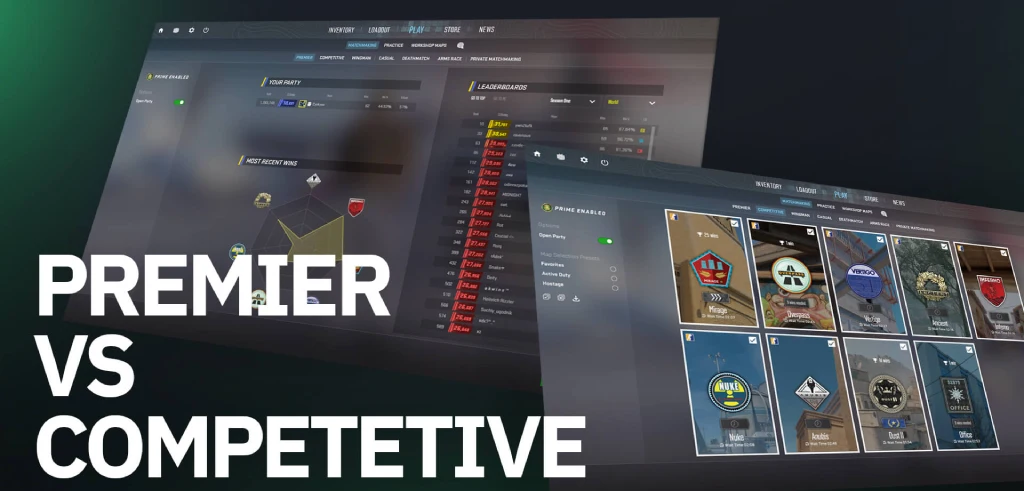
A new mode was also added: Premier. And no, this isn’t just an expansion of the All Game Modes CS2 list. This mode was introduced as the main mode of ranked play in CS2.
It’s significantly closer to the professional scene than the standard Competitive mode in CS:GO. Its main features are:
- CS Rating (ELO) instead of a hidden rank: in CS:GO, players only saw their rank from the CS2 Ranking System list. The internal ranking formula was hidden. In CS2, Premier uses a transparent CS Rating system. It has a numerical rating value, color-coded ranges similar to Dota 2 MMR, and global leaderboards. This makes progress clear and motivating, and the system closer to Faceit/ESEA.
- Map Pick & Ban (Veto System): In the new Premier game mode, each match, like in the professional scene, begins with a map veto. Players ban maps and choose the one on which the match will be played.
- The format and rules are the same as in the professional scene: the most important thing here is the overtime with a fixed number of rounds. When both teams reach 12 rounds, overtime begins. Each overtime consists of six rounds. To win a match, a team must win 4/6 rounds in a single overtime.
CS2 Skins vs. CS:GO Skins
The transition to CS2 affected not only gameplay but also skins. First of all, it’s worth noting that all CS:GO skins were automatically transferred to CS2. Therefore, there are no comparisons of CS:GO vs CS2 skins. Every CS:GO skin became a CS2 skin on the day of the game’s release.
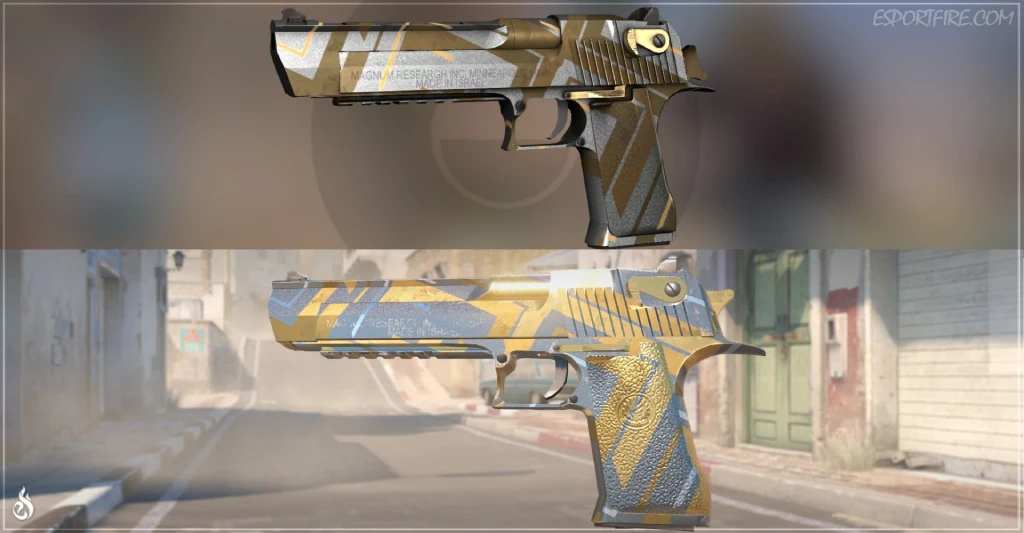
However, there are still some changes. The new Source 2 engine allowed for physically based materials (PBR), different lighting, HDR, and modified tone mapping and contrast. This made the skins a bit brighter, although there are exceptions. Some skins look more faded or dirty, but the realism is truly noticeable.
Skin Lighting Differences
When discussing CS2 skins in more detail, it’s worth discussing the new material and lighting rendering. CS:GO used simplified, essentially “old-school” lighting. The reflection model was quite average, if not bad. In CS2, skins are rendered using physically-based rendering, which offers the following advantages:
- Correct metalness, roughness, and albedo parameters;
- Realistic specular/reflection components;
- More complex BRDF models (how light scatters and reflects off a surface).
Lighting has also become HDR-oriented, which has brought some nice changes:
- Wider brightness range;
- Stronger influence of light sources;
- Harder contrasts in bright areas.
Visually, the changes are as follows:
- Metallic skins (AK Vulcan, M4A4 Howl, many knives, Doppler/Marble Fade) have more pronounced highlights and reflections.
- Glossy finishes now appear deeper, rather than just “bright images on the model.” In dark areas (shadows, interiors), the color palette behaves differently.
- In some places, the skin appears darker, but with a sharper outline.
CS2 vs CS:GO: Which Game Is Better in 2026?
A question many are asking, and frankly, the answer is quite simple. CS:GO was previously relevant for over 10 years. Entire generations grew up on it. However, the developers still did a great job and made CS2 better in almost every way. The new Source 2 engine offers stunning graphics and realistic smoke screens. Also, one can’t help but mention the new Premier mode with MR12 and a new rating system, similar to tournaments. These are all positive aspects.
As for the negatives, here we can only remember the old 128 tick/64 tick. Some players say they feel like they prefer it (they ignore the advantage of the new Sub-tick). Is this just nostalgia? Perhaps.
The system requirements are also worth mentioning. CS:GO was practically playable on a calculator. Comparing CS2 vs CS:GO here is unnecessary; the system requirements have increased significantly. But, this is a reasonable loss for new technological improvements.
FAQ
No. CS:GO is no longer supported or updated. It can theoretically be launched through the Beta section on Steam, but the official servers have long since been shut down. Overall, you can play on CS:GO community servers, but the game is no longer relevant.
Yes, CS2 is significantly more demanding on the CPU and GPU due to the new Source 2. If you compare the FPS in CS2 vs CS:GO on the same old PC, it will be significantly lower in the new version. CS2 runs on a modern graphics model, which may not be suitable for weaker PCs.
CS2 uses physically based rendering (PBR), different tone mapping, HDR lighting, and a modified reflection model. All skins have been slightly reworked, but the textures remain the same.
Yes, CS2 uses volumetric smokes. Smoke is now a physical object that reacts to bullets, HE, and map geometry. It’s now dynamic and can fill space. This is significantly different from CS:GO, where the smoke was a static sprite-cloud and did not interact with the game.
Even Valve likely doesn’t have an answer to this question. Most likely, over the next 5-10 years, the game will be updated through seasonal updates, rather than through the release of a new version. However, who knows? Perhaps in 10 years, we’ll see a new Counter-Strike 3.
Read also: