mn
mn  ru
ru 
Dota 2 History: From Warcraft Mod to Dota 2 Esports Giant
Defense of the Ancients 2 has been on the scene for more than 12 years, maintaining strong popularity throughout its lifespan. While there have been significant changes over the years, the gameplay approach itself has remained unchanged. The key question is how the game continues to engage millions of players worldwide. How did it all begin, and what is the history of Dota 2 esports? We’ll explore this in this article for MelBet Pick’em. Here, we’ll provide a complete breakdown of the Dota 2 timeline. You’ll also learn who created Dota 2 and how difficult and long its journey has been.
The Origins of Dota – The Birth of the Genre and the First Versions
The history of Dota 2 begins with the origins of the genre itself. It established the core features that still define the game today. Dota 2 belongs to the MOBA (Multiplayer Online Battle Arena) genre – a symbiosis of strategy and RPG. In it, the player controls only one hero, develops their abilities, fights in a limited arena, and achieves victory through teamwork and the destruction of the enemy base. These fundamental mechanics made the MOBA genre unique and paved the way for the future legend – DotA.
Herzog Zwei (1989) is widely recognized as the first title to feature proto-MOBA elements. In it, the player controlled a single combat unit, managed a tactical map, and created targeted squads. The mechanics resembled the basic MOBA, but a true turning point in Dota history was the Aeon of Strife map for StarCraft (1998), created by user Aeon64. It featured three lanes, creep waves, and hero selection, leading it to be called the first full-fledged MOBA. Since then, the genre’s development can be traced through specific milestones:
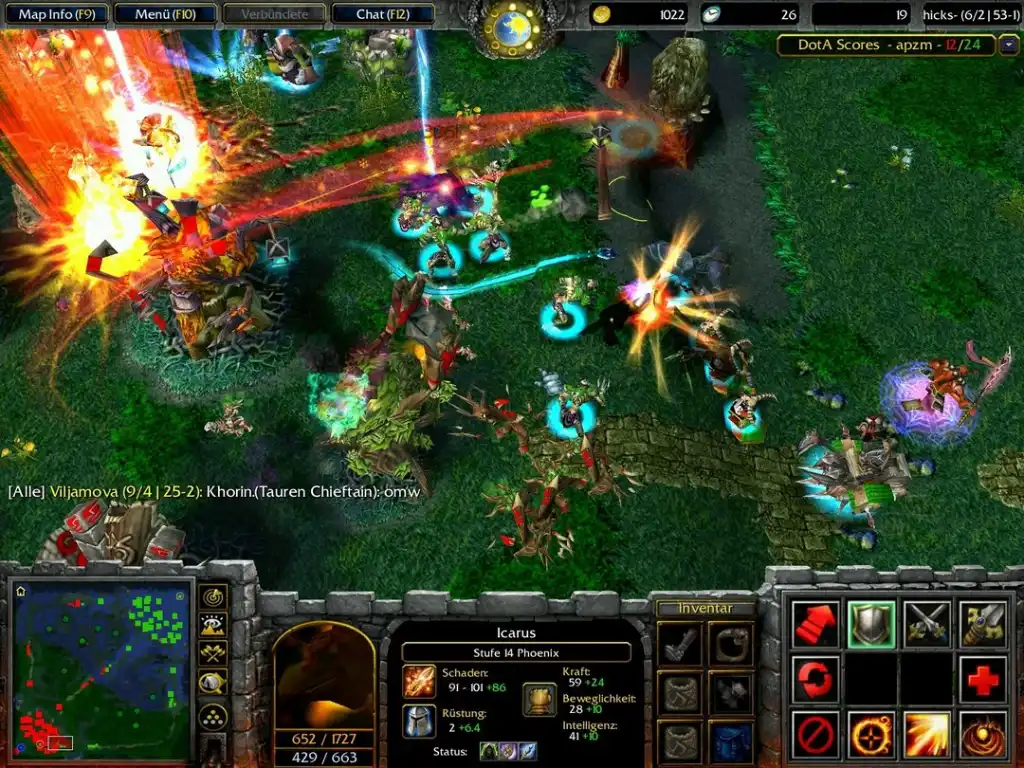
- 2003 – Warcraft III: The Frozen Throne and Defense of the Ancients (DotA). User Eul created the first DotA map, and Guinsoo later added item recipes, runes, and Roshan. By 2009, the mod had over 10 million players.
- 2004 – 2010 – DotA Allstars and IceFrog. IceFrog took over development, brought the balance to an esports level, and made the map the center of Battle.net competitions.
- 2009 – Demigod. The first commercial MOBA from Gas Powered Games. It failed due to piracy, but demonstrated industry interest in the genre.
- 2009 – 2010 – League of Legends and Heroes of Newerth. Riot’s League of Legends and S2 Games’ Heroes of Newerth cemented the genre’s global reach by offering new business models and simplified gameplay.
The Birth of Dota 2 — Valve and IceFrog
By the mid-2000s, the original Dota, built on the Warcraft III engine, had reached its limits. This was due to technical constraints of Blizzard’s Warcraft III engine. The graphics were already considered outdated, the editor was weak, and finally, there were strict limits on scripts and objects. Balancing the game was becoming increasingly difficult, and the audience for the first-ever Dota game demanded more. It became clear that the project needed a full-fledged, standalone version.
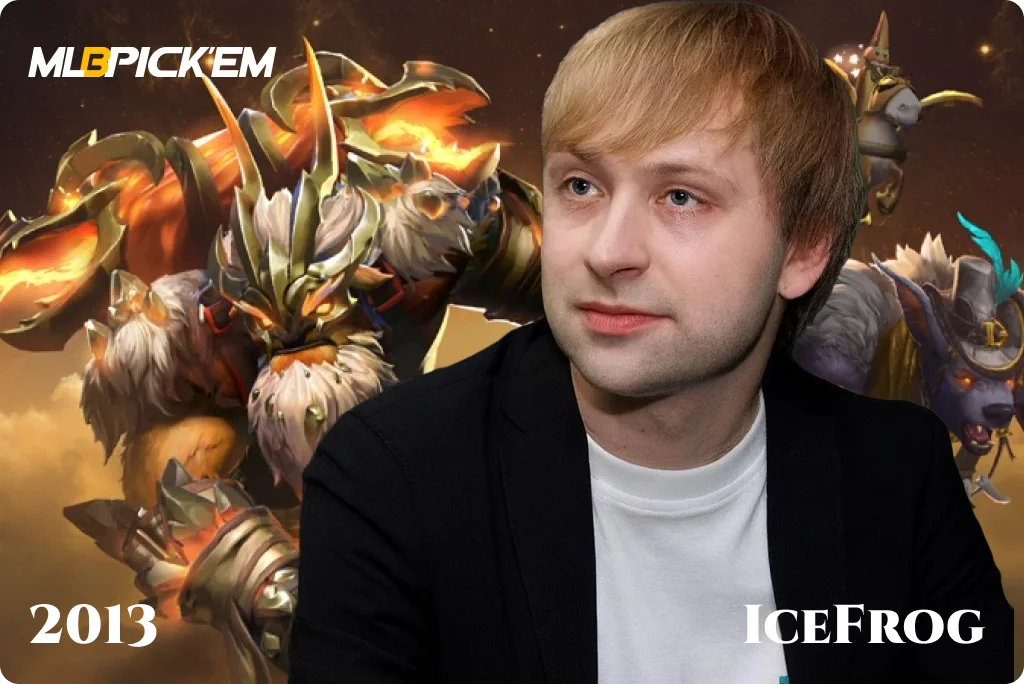
In 2009, Valve made a decisive move that shaped the entire history of Dota. They invited IceFrog (Abdul Ismail), the lead Dota creator. He was responsible for balance, heroes, and mechanics, turning the mod into an esports standard. Along with him, the following people participated in the development of the official Dota 2:
- Eul – the creator of the first version of the DotA map;
- Guinsoo (Steve Feak) – DotA Allstars developer, introduced item recipes and Roshan;
- IceFrog (Abdul Ismail) – lead balancer and architect of the future Dota 2;
- Robin Walker (Valve, Team Fortress) – one of the first to push the idea through the corporation;
- Kendrick Lim – lead artist;
- Jason Hayes and Tim Larkin – composers;
- Marc Laidlaw and Ted Kosmatka – writers who worked on the lore.
Valve didn’t just hire IceFrog. They bought the rights to the DotA brand, entering into direct conflict with Blizzard and Riot (through DotA-Allstars LLC). Blizzard insisted that the name belonged to the Warcraft III community, but in 2012, a court awarded Valve the commercial rights.
How Dota 2 Was Shown to the World: The First International
The first public demonstration of the new game took place at Gamescom 2011. Valve chose a rather unconventional approach: instead of trailers or beta keys, they held the first International Dota 2 with a then-record prize pool of $1.6 million. The first-ever Dota 2 tournament featured 16 of the world’s best teams, and viewers saw Dota 2 in its esports format for the first time.
It proved to be a groundbreaking marketing strategy. The game was immediately associated with elite competition and huge amounts of money, rather than “just another mod remake.” Thus, Dota 2 cemented its place as the number one esports title even before its official release.
On July 9, 2013, the full release was released via Steam for Windows, OS X, and Linux. In 2015, Dota 2 underwent the Reborn update and became the first project to use the Source 2 engine. This not only provided a new interface and graphics but also a foundation for endless updates. Various custom modes, improved performance, and an expanded tournament infrastructure played a significant role in Dota 2 development history.
The Development and Evolution of Dota 2
Following its release in 2013 and the transition to Source 2 in 2015, Dota’s evolution has been through a series of updates, officially called patches. Over the past 12 years, over a hundred patches have been released, but three updates stand out in Dota 2 patch history as defining the entire genre:
- 7.00 (December 2016) – the introduction of the Talent Tree system. It eliminated the need for universal builds, opened up dozens of hero variations, and radically changed the late-game. With this historic patch, Dota 2 developers finally separated the game from Warcraft III and cemented its own Dota 2 origin.
- 7.23 (November 2019) – the introduction of Neutral Items. Farming was no longer limited to gold and shop items. Loot from the jungle became a factor in map control. Dota 2 map history gained a new dimension: neutral items impacted the strategies of all roles.
- 7.33 New Frontiers (April 2023) – the largest redesign in Dota 2’s evolution. The map was expanded by 40%, adding Twin Gates, Watchers, and Lotus Pool. Gold and experience formulas were also completely recalculated. This update rebalanced the macro game and cemented Dota 2 as the most complex MOBA.
As of late 2025, with patch 7.39d, Dota 2 continues to set the benchmark for strategic depth. No other MOBA has made such a journey from fan mod to esports standard.
The role of the community in shaping the history of Dota 2 is equally significant. In 2019, the community gave the world Dota Auto Chess. This mod has amassed over 8 million players in six months and spawned an entire new genre – auto battler.
Valve responded with its own project, Dota Underlords (2020), and earlier released Artifact (2018), a digital CCG set in the Dota universe. While not all of these projects survived until 2025, they demonstrated that the Dota 2 origin story is not just about MOBAs; it is an entire ecosystem influencing the entire gaming industry.
Dota 2 and Esports
As we’ve discussed, the first step toward Dota 2 esports occurred even before its official release. In 2011, The International, the first tournament, immediately launched the discipline’s esports history. That year, the prize money was $1.6 million, $1 million of which went to the champion, Natus Vincere Dota 2. From that moment on, the International (TI) tournaments became the most important in Dota 2 esports history. In football fan parlance, this series of Dota 2 tournaments could be called an annual “world championship.”
The subsequent evolution of the series was quite rapid. Each year, the prize money grew exponentially, creating a new economy in the history of esports. In 2014, the prize pool exceeded $10 million, in 2015 – $18 million, and the record was set at TI10 in 2021 – $40 million. In total, over $200 million passed through tournaments from TI1 to TI14. This cemented Dota 2 as the #1 video game discipline in terms of prize money in history.
The format has also undergone a transformation. Initially, teams were invited directly, but after 2017, Valve introduced the Dota Pro Circuit. This system, where points from Majors and regional leagues determined TI participants, lasted until 2023. Subsequently, the focus shifted to third-party tournaments such as ESL, PGL, and BLAST. This gave Dota 2’s competitive history more flexibility, and the scene a greater diversity that viewers greatly appreciate. Over the years, legendary Dota 2 moments have emerged that have become part of the game’s cultural code:
- Universe’s “$6M Echo Slam” in the TI5 final, which changed the course of the series.
- “Ceeeeeb!” – the cry in honor of Ceb’s incredible initiation at TI8.
- Team Spirit’s comeback in the TI10 final, which became the biggest sensation in Dota 2 history.
- OG’s back-to-back championships (TI8 – TI9) were the first such achievement in esports.
By the end of 2025, Dota 2 tournament history will include 14 The Internationals, dozens of Majors, hundreds of local leagues, and thousands of games watched by millions of viewers worldwide. The International series remains the benchmark by which the development of the entire industry is measured.
The Current State of the Game and Prospects
It’s late and cold autumn outside, and Dota 2 seems to fit in well with it. The game is experiencing a second wind. The online player count in September exceeded 961,289, a record since November 2022. So, even taking into account its age and competition from battle royales, Dota 2 remains the most resilient MOBA in history. Although the online record of 1.29 million players, set in March 2016, still seems out of reach.
However, online player count doesn’t tell the whole story of the game. There are other indicators, and now it’s worth discussing the International tournament series. The problem is that in 2021, the prize pool was a whopping $40 million. Now, in 2025, it has plummeted almost 15-fold, to $2.88 million.
Other issues also need to be addressed: community toxicity, high entry barriers, a weak system for newcomers, and so on. These are the reasons why Dota 2 is becoming a game “for a hardcore minority”.
The future of the game and the esports discipline surrounding it depends on the developer, Valve, and its ability to find a balance between tradition and experimentation. Much can be said, but if we discuss specific options, the return of crowdfunding through Battle Passes, but in a new format, is a plausible option. The introduction of AI into the matchmaking system to improve matchmaking has also been discussed for some time.
FAQ
The first version of DotA (Defense of the Ancients) appeared in 2003 as a custom map for Warcraft III: The Frozen Throne. A user named Eul used the World Editor and laid the foundation for the MOBA genre with two bases, three lanes, and unique heroes.
The original DotA was created by Eul in 2003, but its development was continued by Guinsoo and later IceFrog. Guinsoo added recipes and the Roshan boss, while IceFrog transformed the mod into a balanced competitive arena, changing the entire history of Dota.
Dota 2 was released on July 9, 2013, on Steam. Prior to that, it had been available in beta for two years. Unlike DotA Allstars, Valve’s project was powered by the Source engine. This allowed for improved graphics, a modern matchmaking system, and provided ample room for updates (patches).
IceFrog has been the lead developer of DotA Allstars since 2005 and the lead designer of Dota 2 at Valve since 2009. His primary responsibilities included balancing heroes and creating new mechanics.
The TI tournament series was introduced even before the game’s release in 2011. The first championship surprised the industry with a prize pool of $1.6 million. TI Dota prize pools have steadily grown since then, reaching a record $40 million in 2021. Today, fans of the game rightfully consider this series of tournaments the “world championships” of esports.
Read also: