mn
 ru


CS2 Economy Guide 2026
CS2 is a tactical shooter where weapons and other items are not automatically given or picked up at the start of each round, but purchased with in-game money. This requires not only shooting skills, good reflexes, and map knowledge, but also money management.
This CS2 economy guide for MelBet Pick’em was written to explain to our readers how money is awarded and how to spend it wisely. We’ll examine the various buying types and explain how to make smart purchasing decisions. After reading this guide, you should be able to make better decisions and improve your chances of reaching your desired CS2 rank!
What is the CS2 Economy?
The term “economy” in CS2 refers to the in-game money system, not the skin market, trading, or inventory item prices. While playing any CS2 game mode, you’ve likely noticed that money is awarded for kills, wins, losses, planting the bomb, and defusing it. The more money you earn, the better the weapons and the more grenades you can purchase in the next round.
This is what’s called the economy CS2, and managing this money wisely significantly impacts the overall pace of the game. It’s not always worth spending all your money on weapons. There are certain situations where you need to choose between a full buy, an eco round, or a force buy. This decision must be made by all players on the team.
Moreover, after the transition to the CS2 MR12 format, money management has become even more important. Fewer rounds mean less time to correct mistakes. A poor buy can impact not only the next round, but the entire half of the map.
How the CS2 Economy Works
The CS2 economy is built on the idea that money is awarded for certain actions. This includes more than just kills and winning or losing a round.
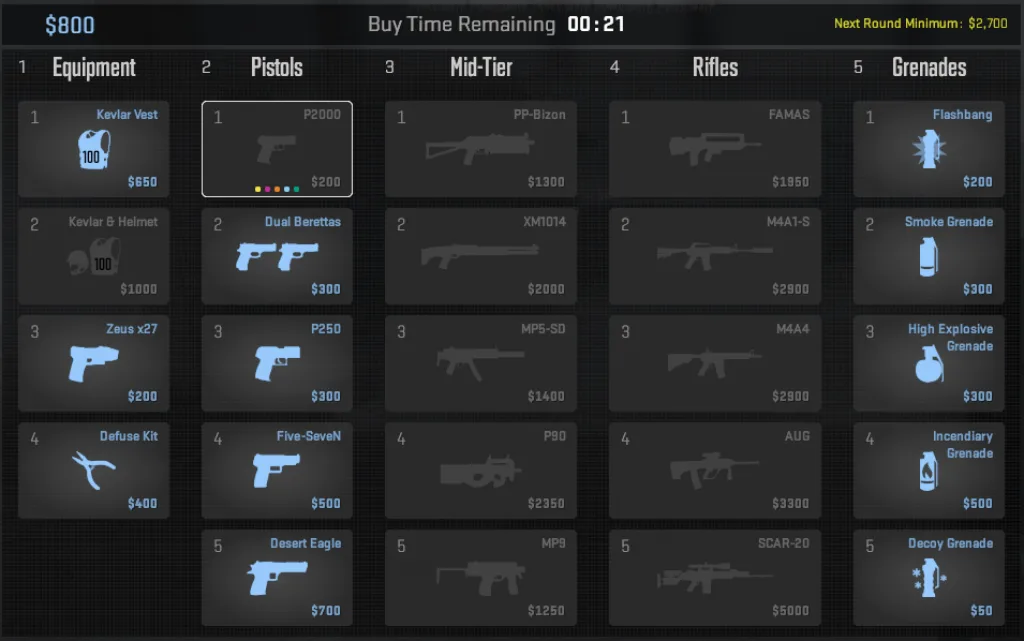
It’s worth starting with the fact that in competitive modes, each player starts a match with $800. This money can be used to buy armor, grenades, a CT-side defuse kit, or an upgraded pistol. Naturally, there won’t be enough money for everything, so it’s important to prioritize the items that are most valuable to you.
It’s also worth considering that the maximum amount a player can accumulate is $16,000. Anything earned beyond this limit is simply lost. Therefore, if possible, when you have a large reserve of money, it’s worth helping teammates with drops.
The main sources of money in CS2 are summarized in this list:
- Kills: The player receives money for kills, but the amount depends on the weapon used to make the kill.
- Round Win: The entire team receives a reward for winning the round.
- Round Loss: The team receives compensation for losing. A loss bonus is activated after a series of lost rounds.
- Bomb Plant: The player who planted the bomb receives an additional personal bonus.
- Lost Round with Bomb Plant: If the T-side planted the CS2 bomb but lost the round, the entire team receives an additional reward.
- Bomb Explosion: The T-side receives an increased reward for winning via a bomb explosion.
- Bomb Defuse: The CT side receives an increased reward for defusing the bomb.
- CT Kill Bonus: The CT side receives a small team bonus for killing terrorists.
It’s important to remember that there is a personal economy, and then there is a team economy. Yes, each player has their own balance, but purchasing decisions should be made by the whole team. Unsynchronized purchases are detrimental to the team; it’s important to consider the overall team balance, the upcoming round, and choose a common plan.
CS2 Kill Rewards by Weapon Type
The amount of money awarded per kill depends on the weapon. This was done to balance the economy. The cheaper and more situational the weapon, the higher the CS2 money per kill.
For example, expensive, high-powered weapons that can kill with one shot often offer smaller kill rewards, usually between $100 and $300. Less expensive SMGs and shotguns typically award two to three times that amount. The knife offers the highest reward, but killings with it are very rare.
| Kill reward | Weapons |
|---|---|
| $100 | AWP, CZ75-Auto, Zeus x27 |
| $300 | Glock-18, USP-S, P2000, P250, Five-SeveN, Tec-9, Desert Eagle, R8 Revolver, Dual Berettas, AK-47, M4A4, M4A1-S, Galil AR, FAMAS, AUG, SG 553, SSG 08, SCAR-20, G3SG1, Negev, M249, P90, Grenades |
| $600 | XM1014, MAC-10, MP9, MP7, MP5-SD, UMP-45, PP-Bizon |
| $900 | Nova, MAG-7, Sawed-Off |
| $1,500 | Knife |

Bomb Plant, Defuse, and Objective Money
The most significant portion of the reward is earned by completing map objectives. Planting, detonating, and defusing the bomb are accompanied by certain payouts, including CS2 round win money. It’s also worth considering that, for example, for the T-side, planting the bomb in a CS2 eco round is often more profitable.
This is because the chances of winning by eliminating the entire enemy team are very low. Weak pistols and a small number of grenades don’t provide an advantage. However, planting the bomb in this case, even if the round is lost, earns the team an $800 bonus for each player. This can positively impact future buys.

The CS2 money system is explained in more detail in this table:
| Action | Who receives the money | Amount | Economic meaning |
|---|---|---|---|
| Bomb plant | The player who planted the bomb | $300 | Personal bonus for planting the bomb |
| Lost round with bomb plant | Entire T-side | +$800 per player | Even after losing, Terrorists receive extra money for the plant |
| Bomb explosion wins | Entire T-side | $3,500 per player | Winning through a bomb explosion gives a higher team reward |
| Bomb defuse win | Entire CT-side | $3,500 per player | Winning through a defuse gives a higher team reward |
| Bomb defuse personal bonus | The player who defused the bomb | $300 | Personal bonus for a successful defuse |
| Standard round win | Entire team | $3,250 per player | Standard wins by eliminating all opponents or running down the timer |
| Dying after time as T-side | T-side player | $0 in the next round | If the bomb was not planted, dying over time damages the personal economy |
It’s also worth noting the rule regarding death after the timer expires on the T-side. If the bomb wasn’t planted, then dying after the timeout will result in the Terrorist receiving $0 in the next round. Therefore, it’s important to either save your weapons or die before time runs out.
What Is Loss Bonus in CS2?
Consider what happens if one team loses three or more rounds in a row. Theoretically, they’ll continue to lose and simply have no chance, since the payouts for losses are minimal, and the winning team has a huge pool of money.
So, to prevent this imbalance, a special CS2 loss bonus was created. It increases the payout for each subsequent loss in a row by $500. After five consecutive losses, the reward can allow you to reach a full buy thanks to the higher loss bonus.

| Consecutive losses | Loss bonus per player |
|---|---|
| 1st loss | $1,400 |
| 2nd loss | $1,900 |
| 3rd loss | $2,400 |
| 4th loss | $2,900 |
| 5th loss and beyond | $3,400 |
Main CS2 Buy Types and Economy Strategies
To avoid having to constantly negotiate with long sentences like “Let’s eco this round” or “Let’s buy as much as possible this round,” special buy types were invented. Simply type a short “eco” or “force buy” in the chat, and if your teammates are on board with your idea, they’ll understand and follow the buy.
However, to choose truly appropriate buy strategies, it’s important not only to know the names but also to understand when each buy is appropriate. You need to consider not only player balances but also several other factors. Below, we’ll examine all CS2 buy types in detail and explain when it’s best to use each one.
Full Eco / Save Round
A full eco, or save round, is a round in which a team buys almost nothing. In most cases, players keep their standard pistols or make minimal purchases, such as another pistol or armor. This strategy essentially sacrifices one round for a stronger position later.
However, this doesn’t necessarily mean you should simply lose the round. The T-side can try to plant the bomb, which provides a very good bonus. The CT side often stacks on one site, trying to take weapons from the opponent.
The full eco CS2 strategy is suitable in the following situations:
- When the team doesn’t have enough money to fully buy rifles, armor, and utility.
- When a force buy could ruin the economy for the next round.
- When the loss bonus allows for a good buy after one save round.
- When the team has lost several rounds and needs to stabilize the economy.
Half Buy / Semi Buy
Between a CS2 eco round and a full buy, there’s an intermediate option, which players call a half buy or semi buy. It’s based on buying inexpensive weapons, usually upgraded pistols, MP9, MAC-10, Galil, or FAMAS. Sometimes armor and some utility are also purchased.
The idea is to spend only a portion of your available funds to have a decent chance of planting the bomb, killing a couple of opponents, or even unexpectedly winning a round. The remaining funds should be enough for a full buy-in in the next round.
CS2 half buy is most often useful in the following situations:
- When the team has money, but not enough for a full buy.
- When, after a limited buy, it’s possible to buy properly in the next round.
- When you need to try to inflict economic damage on the opponent.
- When the T-side can play for a fast bomb plant.
Full Buy
The ideal combat buy, which teams usually aim for, is called a full buy. This is precisely why teams play eco or half-buy rounds. As for the buy itself, players buy the best rifles, armor, and grenades. The CT side often adds defuse kits. This gives the team the greatest possible tactical potential.
It’s also interesting to note that for the T-side, the standard CS2 full buy is usually an AK-47, armor, and a full set of utility. For the CT side, it’s an M4A4 or M4A1-S, armor, grenades, and at least a few kits for the team.
When to play a full buy:
- When most, or ideally all, players can buy a rifle, armor, and utility.
- When the round is crucial for maintaining the economy or turning the tide.
- When there’s money for drops for players with weaker economies.
Force Buy
A force buy is a common strategy, although beginners often overuse it by spending every last dollar. It’s essentially a risky buy where the team uses almost all available funds. Each player buys the best they can afford, even if losing the current round will leave the economy very weak.
The main idea behind a CS2 force buy is to win the round at any cost. This can dramatically turn the game around, especially if the opponent isn’t expecting resistance. However, the downside is that if the team loses the force buy, it will be forced to play eco in the next round.
A force buy can be considered a viable strategy in the following cases:
- When it’s the last or near-last round of a half.
- When the score requires immediate risk.
- When the opponent also has a weak economy.
- When the team is confident in a specific strategy for this buy.
Hero Buy
Hero buy is a strategy in which one player buys a powerful weapon while the others save. The idea is to give the strongest player a chance to make a key impact. Typically, this player buys an AWP or rifle, while the other teammates stick to pistols.
Good team communication is essential. For example, the AWPer occupies a key position, while teammates support them with flashbangs or information gathering. If communication is poor, a CS2 hero buy usually turns into a pointless risk.
This buying strategy can be considered in the following situations:
- When one player has a lot of money, and the others want to conserve their economy.
- When the team understands how to use the weapon.
- When the AWP or rifle can fulfill a specific role in the round.
- When it doesn’t disrupt the team’s future buy.
Anti-Eco / Farming Round
The next strategy is based less on available funds and more on logic. If you think your opponent will be playing an eco or a weak force buy, you can try a CS2 anti-eco buy. The goal of this round isn’t just to win, but to gain an economic advantage. A team buys SMGs or shotguns because they’re cheaper than rifles and yield higher kill rewards.
It’s easier to understand this strategy using a practical example. It works best when, after winning a pistol round, you expect your opponent to play with pistols. By buying a MAC-10, MP9, or shotgun, you can relatively easily win the round and earn even more kill rewards while preserving your funds for future rounds.
Anti-eco can work in the following situations:
- When you’re confident your opponent is using an eco or a weak buy.
- When a team has won a pistol round and wants to farm money with SMGs.
- When you need to build an economic advantage for several rounds to come.
Bonus Round
A bonus round is a round in which a team keeps weapons from a previous low buy or anti-eco round. For example, after a win with a MAC-10, MP9, or Galil, a team decides to keep these weapons and play the next round without reinvesting fully. This allows them to accumulate more money and build a stronger economy for the future.
Essentially, the main idea is to get the maximum value from the weapons they already have. Yes, a full rifle buy is strong, but replacing a usable weapon is not always efficient. The CS2 bonus round is designed specifically for such cases, because if the team wins it, the economic advantage becomes enormous.
A bonus round can be used in the following situations:
- When a team won the previous round with SMGs, Galils, or FAMAS.
- When it makes sense to save money and not buy rifles right away.
- When even a defeat won’t ruin the economy.
Pistol Round Economy in CS2
The first round for each side is called a pistol round. This is because players have no access to SMGs, rifles, or shotguns. With an $800 budget, you can only buy an upgraded pistol, armor, or utility. Also, if playing on the CT-side, it’s advisable to purchase at least one defuse kit for the team.
After losing a CS2 pistol round, a team has two main options: eco or force buy. In the case of a CS2 eco, you can quickly reach a stable full buy, while a force buy is usually worth considering if you have a plant bonus and want to try to regain control.
After winning a pistol round, it’s advisable not to rush into a full buy. It’s better to buy SMGs, armor, and utility to earn extra money for future rounds; your opponent’s inventory will likely be even weaker.
How to Track the Enemy Economy
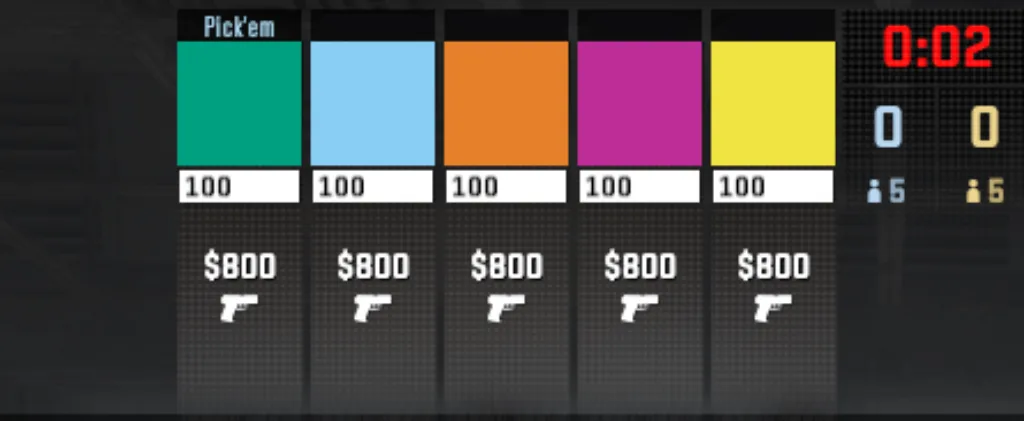
To win, you need to not only manage your own money wisely but also monitor your opponent’s economy. By correctly predicting your opponent’s eco, force buy, or AWP buy, you can choose a safer tempo, utility, and even ideal positions in advance.
The easiest way to assess your opponent’s economy is to monitor their win/loss streak, the number of surviving players, and whether the bomb was planted. For example, if a team loses a round but has two rifles, that’s a completely different situation than a complete loss without saved weapons and without a plant bonus.
Based on this example, we’ve prepared several typical situations to help you better predict your opponent’s economy.
Reading the Opponent’s Loss Bonus
Always keep an eye on the CS2 loss bonus. If your opponent loses several rounds in a row, their loss bonus increases, and they may suddenly go for a full buy even after another loss. This debunks the myth that a team is always poor after a loss. A losing streak actually gives them the money to invest in a strong buy, which can help turn the tide.
Predicting Enemy Eco Rounds
Eco rounds are quite easy to predict. They usually occur after a lost pistol round or an unsuccessful force buy. If you think your opponent will play eco next round, consider anti-eco. Also, keep in mind that the main mistake against Eco is playing too confidently.
When to Expect an AWP
If you know an opponent has saved an AWP from the previous round, you should definitely adjust your round plan accordingly. Such situations require more smokes, flashbangs, or molotovs. The AWP can be especially devastating when playing T-side; long lanes should be reliably covered with smokes.
Team Economy Tips for Better Matches
We’ve already noted that team economy in CS2 is more important than personal balance. A large sum of money in one player’s account doesn’t guarantee a strong round if everyone else is running around unarmored and armed with pistols.
Therefore, to properly convert money into a real in-game advantage, we’ve prepared some tips. They explain why it’s sometimes better to give a teammate a drop than to buy yourself an extra grenade.
- Communicate every buy round: At the start of each buy phase, quickly agree on the team’s purchase. This is best done in CS2 voice chat, but sometimes simply typing “full buy,” “half buy,” or “eco” in text chat is enough. Of course, this doesn’t guarantee that all teammates will listen, but you might get lucky with your teammates.
- Drop weapons for teammates: If you have a large supply of money, but your teammate doesn’t have enough for a rifle, AWP, armor, or utility, it’s better to drop a weapon. This can have a greater impact on the round and the game overall than your personal stock of several thousand. We also recommend using the scoreboard to check the player’s performance and what they are asking for. While they might be playing very well, it’s also possible that they’ve only made one kill in five rounds.
- Don’t buy alone when your team is saving: Don’t buy an AK-47, M4, or AWP alone while your team is playing eco. Such solo buys rarely change the outcome of a losing round, leaving you without money for the next full buy.
- Prioritize utility, not just rifles: Some players ignore utility when on a budget. This is absolutely not a good idea, as without utility, a team often simply can’t properly enter a site, stop a rush, or retake. It’s often worth taking a cheaper weapon to buy a few grenades.
- Think two rounds ahead: Consider not only the current situation, but also the next one. Consider in advance what will happen if you lose this round. Will you have enough money for a full buy-in in the next round? Should you buy an AWP now or maintain team balance? You should only ignore future rounds during the last stage of a half.
Conclusion: Mastering the CS2 Economy
Now, after reading our CS2 economy guide, you’ll likely be better able to plan your purchases in future rounds. Remember, the economy is all about teamwork. Share this guide with your friends who play with you. If you’re playing with random teammates, you can briefly explain each strategy before the match begins. We’re sure they’ll appreciate it!
FAQ
The amount of money awarded for a kill in CS2 depends solely on the weapon used. Most pistols, rifles, and grenades award $300 per kill. Most SMGs, with the exception of the P90, award $600, and most shotguns a whopping $900. Kills with the AWP, Zeus x27, and CZ75-Auto award the least — only $100 — while the highest reward is awarded for a knife kill.
A standard round win rewards each team member with $3,250. However, if the victory is achieved by completing an objective, detonating a bomb for the T-side or defusing it for the CT-side, the reward is higher, reaching $3,500 per player.
A knife kill in CS2 rewards a player $1,500, making it the highest kill reward in the game. This is because knife killings are incredibly rare. In most competitive matches, not a single player is killed with a knife in the entire game. Especially when the opponent has at least a pistol, a knife kill is incredibly risky.
An eco round in CS2 is a scenario in which a team buys almost nothing. This is necessary to conserve most of the money for a future full buy. In other words, the goal of such a round is not necessarily to win, but simply to stabilize the economy and come out stronger in the next one.
The maximum money limit in CS2 is $16,000 per player. Any additional money beyond this amount is not saved. Therefore, if you have a large reserve, it is recommended to drop weapons for teammates to balance the team economy.
Read also: