mn
mn  ru
ru 
What Is ADR in CS2? Quick Beginner Guide
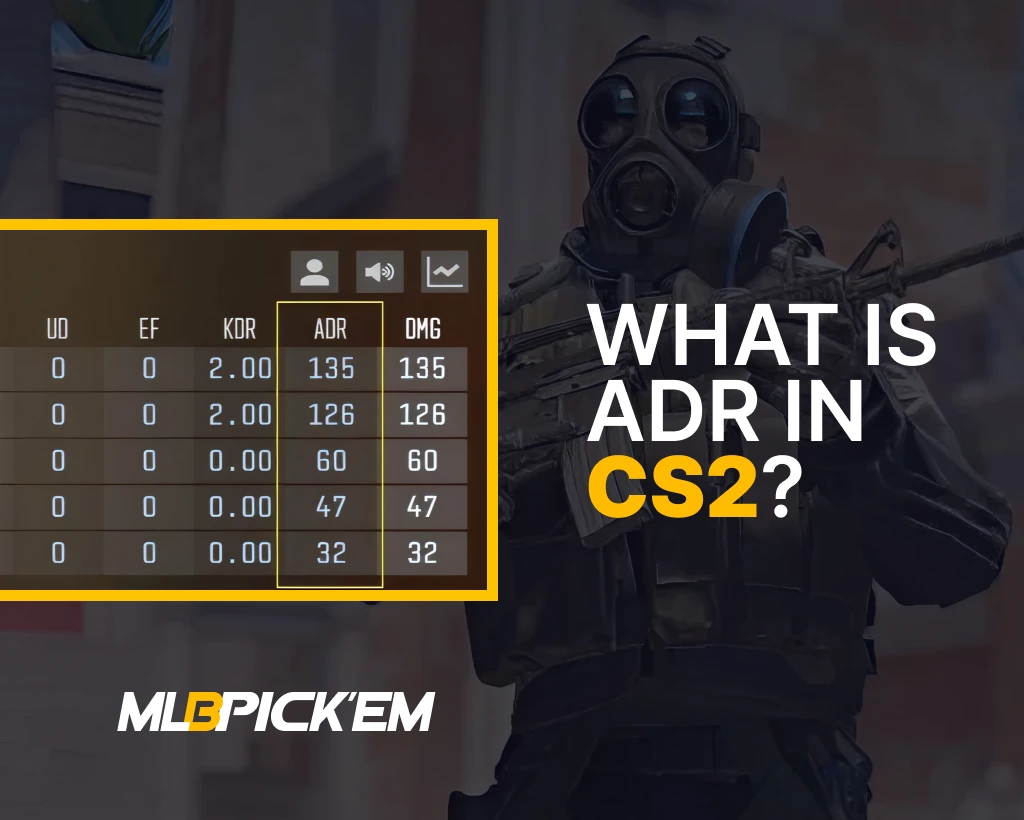
Statistics have always been an important part of Counter-Strike. Players used to judge effectiveness by kills and K/D, but today, ADR CS2 has become the key metric. In this MelBet Pick’em article, we’ll break down what is ADR CS2, why this metric matters, and how it reveals your real impact beyond simple kills and K/D. We’ll also tell you what ADR is considered good, compare it to others, and even provide the results of professional CS2 players!
What Exactly Is ADR in CS2?
ADR (Average Damage per Round) is the average amount of damage a player deals to opponents in a single round. In professional terminology, ADR meaning CS2 refers to a metric that evaluates a player’s real, repeatable impact rather than just raw frag count. This is the main reason analysts and professional players call ADR one of the most honest and objective indicators of in-game performance.
What Damage Counts Toward CS2 ADR?
Almost all damage counts toward the CS2 ADR statistic. The only exceptions are damage to teammates or self-damage. To avoid any unnecessary questions about ADR, we’ve prepared a list of damage types that are included in this statistic:
- Bullet damage (all weapons).
- Grenade damage (HE, Molotov, Incendiary, Frag).
- Knife damage.
How Is ADR Calculated in CS2?
Besides knowing what is ADR in CS2, you also need to know how it’s calculated. There’s only one formula for calculating ADR in CS2:
- Average Damage per Round = Total Damage Dealt ÷ Rounds Played
Let’s imagine you played a 20-round match and dealt 1,400 damage:
- 1,400 ÷ 20 = 70 ADR CS2
Your ADR in this case is 70, which is typical for an average CS2 player.
How to Check Your ADR in CS2
ADR is likely the most in-demand CS2 metric in 2026. There are a lot of queries like “how to check ADR CS2” and “where to find ADR CS2”, and we’ve prepared simple but effective answers for them. Here we’ve compiled three main ways to check ADR. The first two work in-game, while the third provides more detailed statistics but requires a third-party service.
1. How to View ADR in CS2 During a Match
This is the fastest way to view CS2 ADR in real time:
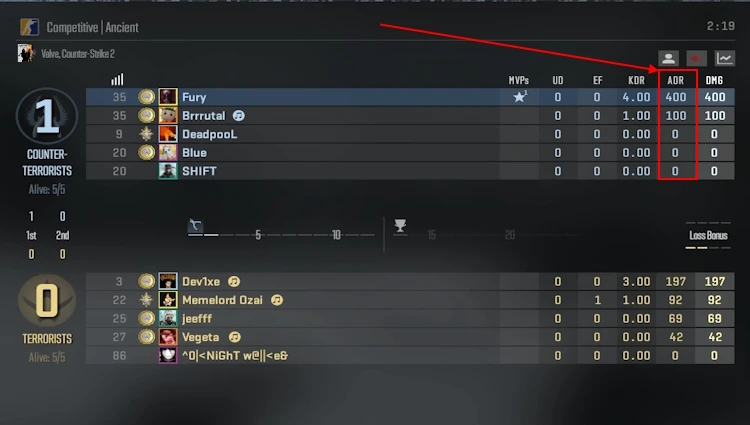
- Press TAB to open the scoreboard.
- Right-click to activate the cursor.
- In the upper-right corner of the scoreboard, click Cycle Stats (the graph or statistics icon).
- In the panel that opens, find the ADR column.
Now you’ll see all ADR stats (your own, your teammates’, and your opponents’). This method is used most often, as tracking ADR during a match is quite interesting. Just one glance allows you to evaluate yourself, your opponents, and your rivals. Maybe someone should be kicked or praised? Average damage per round shows this.
2. How to View ADR CS2 After a Match
The second method is ideal for assessing ADR after a match. Here’s how it works:
- After the game ends, CS2 will automatically open the Match Summary.
- Player cards will display three key stats: K (Kills), A (Assists), D (Deaths), and ADR (highlighted with a separate number below them).
- You can click “Detailed Stats” to see expanded stats, where ADR is displayed along with other stats.
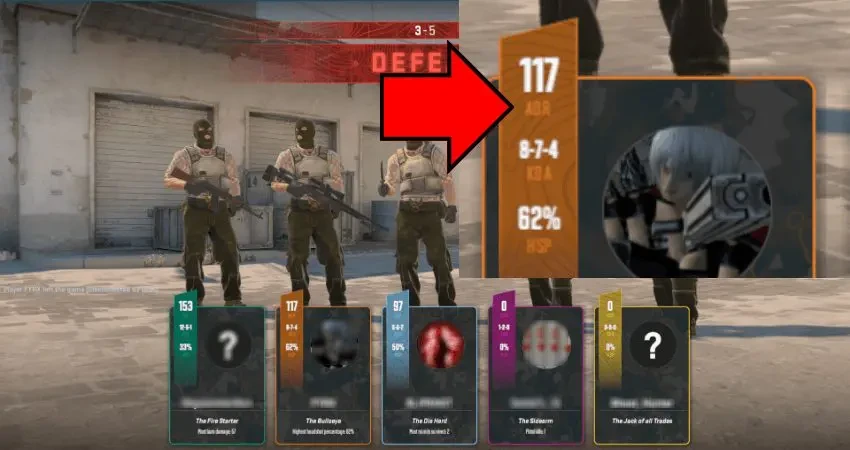
3. How to View ADR Through FACEIT
If your Steam account is connected to CS2 FACEIT, you can see your ADR in deep analytics, which isn’t available in the game launcher. FACEIT automatically collects statistics for all matches, including metrics that CS2 doesn’t directly display. You can also use Faceit to look at your average ADR over dozens, or even hundreds, of matches:
- Go to FACEIT.com.
- Go to Profile → Stats tab.
- Select: CS2 and season/date range.
- In the Match Statistics section, you’ll see your ADR and a bunch of other statistics.
This method of checking ADR is also great because you can filter by map, compare it to players of your skill level, and see the correlation between ADR and Winrate.
What Is a Good ADR in CS2?
If you pay close enough attention to the end-of-match stats, you’ve probably wondered what kind of CS2 ADR is considered good? There’s no definitive answer, but the higher the better.
Based on global statistics, ADR in CS2 can be broken down into six tiers. This isn’t the most objective breakdown, but it’s good enough to help you understand what’s good and what’s not.
Also, towards the end of the article, we will present the highest ADR CS2 professional players from the leading teams of Tier-1 tournaments. This will also allow you to compare your ADR with that of professionals.
| Player Level | Average ADR CS2 |
|---|---|
| Beginner | 20-40 |
| Lower-Mid | 40-60 |
| Mid-Level | 60-70 |
| High-Level | 70-80 |
| Tier-1 Professional | 70-85 |
Why High CS2 ADR Doesn’t Always Mean High Skill
You might say that 80-100 ADR in CS2 isn’t enough, and you’ve seen a couple of times where the ADR was 120 or higher at the end of a match. Yes, you’re partly right. Such values do happen. However, there are important nuances.
The table shows the average CS2 ADR. That is, it’s a statistic calculated over hundreds of matches, divided by the number of games. So, if you or a friend scored 120 ADR in one game, and 60 in another, the average would be 90. Is that still a good stat? Let’s say you scored 60 in the third game, the average would be 80, and so on.
There’s also another important point to consider. Professional players have ADRs in the 80-100 range precisely because they compete against other professionals. This means the most skilled players in the world are playing against the most skilled players in the world. This is incomparable to the situation where you reach 80-100 ADR while playing against regular players in Premier or matchmaking. It’s a completely different level of stress and difficulty.
Therefore, in addition to comparing the highest ADR CS2, it’s important to also compare the conditions under which it’s achieved. And the conditions are definitely different for players of different skill levels.
ADR vs KDR vs HS% vs Utility Damage
To confidently say that ADR in CS2 is better than any other metric, a comparison is needed. We’ve prepared a brief but informative table outlining the strengths and weaknesses of each of the four main metrics.
| Stat | What it shows | Why it’s useful | Where it can mislead |
|---|---|---|---|
| ADR | Your consistent round-to-round impact through damage | Best indicator of overall contribution, even without kills | Doesn’t account for role or the context of the damage dealt |
| KDR | How often you win duels and stay alive | Good for evaluating individual aim and survivability | Can be inflated by passive play; ignores actual damage impact |
| HS% | Mechanical precision and aim quality | Highlights a player’s style and raw mechanics | High HS% doesn’t mean high impact or consistency |
| Utility Damage | How effectively you use grenades to control space | Shows tactical understanding and map awareness | Depends heavily on role; low UD isn’t always negative |
Why ADR Matters in CS2
We’ve already mentioned many times in this article that this metric is one of the most accurate and shows real impact. Now it’s time to explain why everyone loves ADR in CS2:
- It shows real impact, not just kills.
- It directly affects a team’s win rate.
- It’s considered an indicator of stability, not random moments.
- It takes into account the contribution of all roles, including support.
How to Improve Your ADR in CS2: Pro-Level Tips
Want to increase your average damage per round? Well, it won’t be easy, but it’s entirely possible. We’ve prepared a whole list of tips from the pros. It will help you increase your ADR in CS2, but remember that it’s not individual tips that work best, but rather a combination of them:
- Keep your crosshair at headshot height in 100% of situations.
- Learn to pre-fire pre-rolls into common positions.
- Throw HEs with precise timing, not “hoping to hit.”
- Use Molotovs to knock out supports and AWPers from corners.
- Deal damage even if you don’t get a kill. ADR will count.
- Play for trades, not solo picks.
- Read your enemy’s economy to understand when they’re without armor (they do more damage).
- Play positions that offer the potential for multiple encounters, not just one pick.
- Learn the specifics of each map – ADR on Inferno is earned differently than on Nuke.
ADR in Professional CS2 — Real Pro Examples
The most interesting thing is, of course, the ADR pro CS2 players. And here the situation is very interesting. If you take players from the best teams in the world, you’ll find that their average CS2 ADR is around 70-80, with rare exceptions. For example, FalleN from team FURIA has an ADR of only 69.9.
Many players, seeing the ADR of these pro players, are surprised: “How can this be? I sometimes have ADRs of 90+ in Premier.” But comparing these numbers directly is a huge mistake. In Tier-1 matches, opponents are in the top 1% of players in the world, so every match is much more difficult than in Premier.
FAQ
Professional CS2 players typically have an average damage per round in the 70-85 range. These are fairly high values for matches against the strongest opponents. The highest average value in the pro scene was once held by donk (99.9) from Team Spirit.
Yes, grenade damage is fully accounted for in ADR. This typically includes HE, Molotov, and incendiary grenades. However, there are rare cases of damage from flashbangs when an enemy falls. These are also accounted for.
Yes, this is a very common situation. The player can deal a lot of damage each round, but not finish off opponents. In such cases, ADR remains high, and kills are correspondingly low.
Read also: